The Fragment of a US Navy 32-Pounder of 46 Hundredweight at Fort Branch
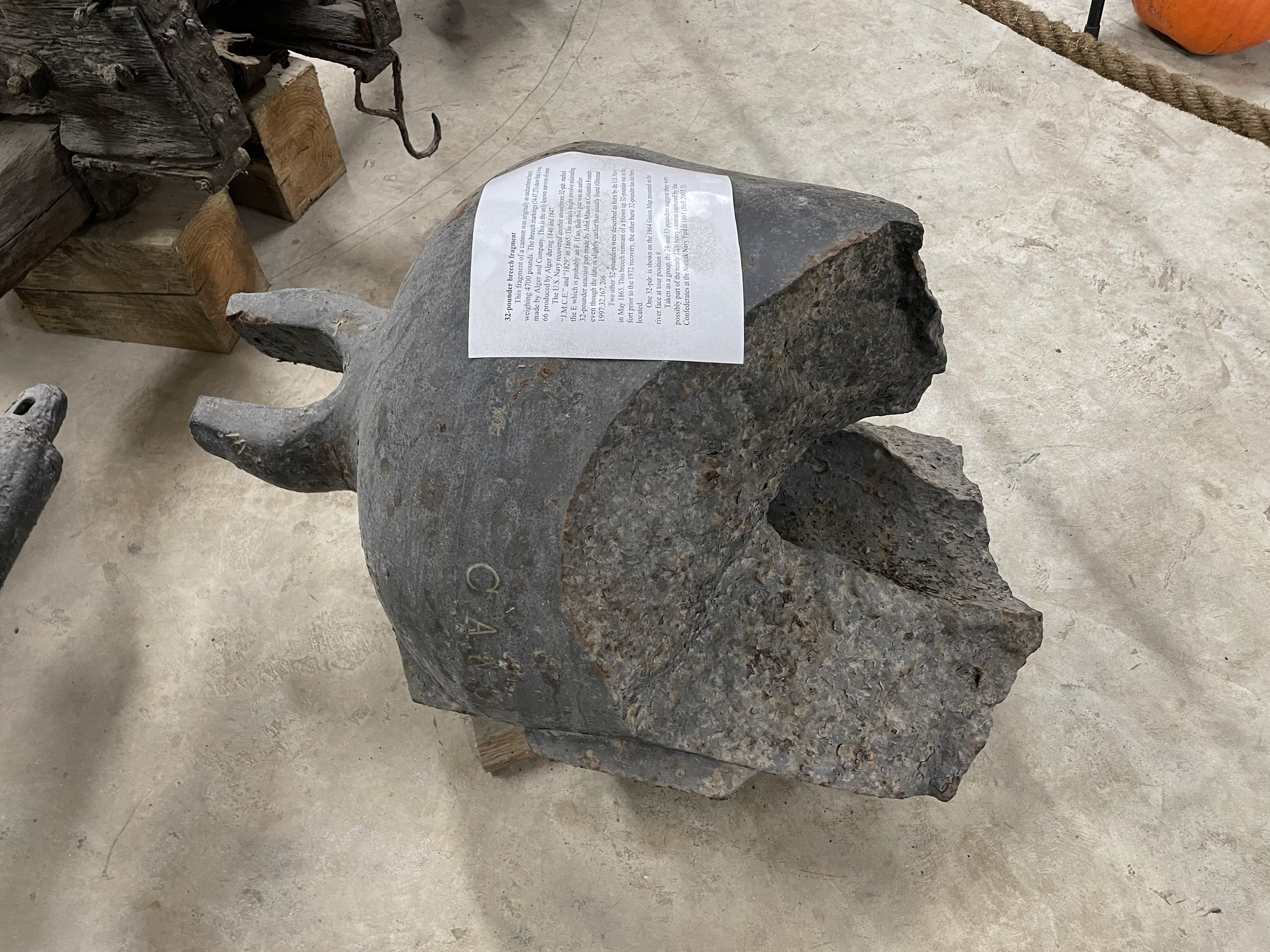
A fragment of the breech of Number 34 at Fort Branch is all that remains of sixty-six 32-Pounders of 46 Hundredweight which were cast in 1846 for the frigates USS Constitution and USS United States.
USS United States, one of the original “Six Frigates” of the United States Navy, is best known for her defeat of HMS Macedonian October 30th, 1812 and in the literary world for being the ship that Herman Melville sailed upon and the inspiration for the novel White Jacket. Civil War buffs might know that she survived the bonfire at Gosport in April 1861 to be commissioned into the Confederate Navy as CSS United States. The final foreign voyage of USS United States had been from 1846 to 1849 when she was first flagship of the Africa Squadron which worked to suppress the slave trade and then part of the Mediterranean Squadron. She returned to Norfolk in 1849. For this final voyage, she was reequipped with a battery of new 32-Pounders specially designed for her and her famed sister, USS Constitution.
Engagement Between the "United States" and the "Macedonian" by Thomas Birch
Part of the remarkable collection of artillery at Fort Branch on the Roanoke River is a fragment of a 32-Pounder. Olmstead et al. identifies it as the only surviving portion of the sixty-six 32-Pounders of 47 Hundredweight cast for the US Navy by Cyrus Alger in 1846. (There is some question over the designation. Olmstead uses “47 cwt” while historical sources use “46 cwt”. All but four cast were over 47 cwt.) Olmstead notes that the breech is marked: Cyrus Alger, Registry Number 34, Weight: 47-0-27 (5,291 pounds).
In May of 1845, a board of US Navy Captains recommended a system of ordnance for the navy. Their report called for the Navy to standardize on the 32-Pounder. Whereas ships had previously carried 18-Pounder, 24-Pounder, 32-Pounder, or 42-Pounder main batteries depending on the size of the ship with carronades on spar decks or as the main battery of small ships, in the new system, all would be replaced by 32-Pounders of different weights. What would vary would be the maximum powder charge each model could handle.
Table from John Dahlgren’s “Shells and Shell Guns” - Page 26
Heavy frigates used the 32-Pounder of 57 Hundredweight for their main battery. John Dahlgren dismissively notes that the “32-Pounder of 46 cwt was only designed for a few frigates of inferior rate” before describing how the 42 cwt, 32 cwt, and 27 cwt models were intended for various sizes of sloops and the upper decks of larger ships (Dahlgren, John. Shells and Shell Guns. Pp. 23-24).
It turns out, the “few frigates of an inferior rate” referred to by Dahlgren were none other than the two most famous frigates in the Navy: USS Constitution and USS United States. A Navy that was built on the legacy of the victories in the War of 1812 and largely led by officers who had seen action in the War of 1812 almost to the eve of the Civil War, went out of its way to keep USS Constitution and USS United States in service. To underline that point, USS Constitution is still in service and its possible that United States might be had the Civil War not intervened.
Constitution and United States had been the model for all subsequent US Navy heavy frigates, but the frigates built in the 1820s were larger - about 18 inches wider on the beam - and of greater displacement. These larger frigates were capable of carrying the heavy 32-Pounder of 57 Hundredweight. Constitution and United States simply couldn’t. So, it appears that the Navy ordered a special run of 32-Pounders of 46 Hundredweight for these two ships. These 32-Pounders approximated the weight of the 24-Pounders that the ships were originally designed to carry. And they were the last guns that the two old frigates carried in service as active cruising ships of the navy (as opposed to the batteries they would later carry in training roles).
While I should be clear that the fragment of 32-Pounder of 46cwt Number 34 is neither a witness to USS United States’s victory over Macedonian nor Hermine Melville’s service aboard, it is a witness to the last voyage of USS United States, the service of the US Navy on the Anti-Slave Trade Patrol, and a tangible connection to one of the Navy’s most famous ships which has left scant few other relics which survive to this day.
Main Deck Battery of USS United States in Record Group 74, Entry 111 "Records of the Armament of Naval Vessels, 1842–1903"
When Virginia Secessionists seized Gosport Navy Yard in April of 1861, they took almost 1,200 naval guns for the Confederacy. Among them were the thirty 32-Pounders of 46 Hundredweight aboard USS United States. National Archives Record Group 74, Entry 112 "Registers of Naval Guns, 1842–1900" records most of the series from registry number 1 through 35 as “Seized by the Rebels at Norfolk on board United States, 1861”. The registry goes on to note that several were recaptured including examples at Fort Hatteras and Fort Fisher.
Number 34 was taken to Fort Branch. At some point there it burst - possibly during the evacuation of the fort in 1865. Unlike the intact guns which were overturned into the Roanoke River to be recovered in the 1970s, this fragment was left in the fort.
Fort Branch has an incredible collection of original artillery and surviving carriages. If you can manage to attend on one of the days that the site is open, please do so. (Please note, in 2025 the museum in which this collection was housed was heavily damaged by a falling tree. I am not sure of the current disposition of the collection. Check with the custodians of the site before making arrangements to visit.)
The Breech Fragment beside a 4-Inch Blakely and an iron 6-Pounder with portions of original carriages.
The marking of Cyrus Alger and Company on the Breech. I couldn’t photograph the registry number or the weight which were facing down.
An intact 32-Pounder of 57 Hundredweight in Hudson, New Hampshire. The 32-Pounder of 46 Hundredweight looked very similar but was 10 inches shorter and of slightly smaller dimensions.