US Army Rodman Guns of the Civil War
The video version of this post is linked above.
See photos of surviving Rodmans: https://www.santee1821.net/preserved-artillery/tag/Rodman
One of two massive 15-Inch Rodman guns mounted at Fort Foote near Washington, DC overlooks the Potomac River. In March of 1862, it seemed all too possible that the ironclad CSS Virginia would steam up the Potomac and bombard the capital, and little could have been done about it as the heaviest gun in the city was a single 11-Inch Dahlgren in the experimental battery at the Washington Navy Yard. The guns at Fort Foote and Battery Rodgers across the river in Alexandria were placed to make sure that sort of attack could never succeed. The 15-Inch Rodman was capable of cracking open any armor carried afloat during the American Civil War, but how did the US Army get to have such massive guns?
US Army 42-Pounder, Fort Pulaski https://www.santee1821.net/preserved-artillery/us-army-42-pounder-pattern-1831-at-fort-pulaski
Just over 20 years before, the heaviest gun in US Army inventory was a 42-Pounder. The 15-Inch Rodman weighed nearly six times more than the old gun and fired a shot weighing ten times as much.
What drove this huge increase? The twenty years from 1840 to 1860 saw the widespread introduction of steam powered ships and explosive shell-firing guns.
The 24-Pounder, 32-Pounder, and 42-Pounder guns which armed the US Army forts designed and built in the first decades of the 1800s were adequate for dealing with similarly armed sailing ships. Ships under sail had to wait for ideal conditions of tide and wind to enter a harbor - the approach by necessity would be slow. A ship picking a fight with a fort while simultaneously navigating the narrow channel of a harbor’s entrance under sail would not do well. The fort’s guns had the whole target of the ship and its rigging to damage and disable the vessel. Firing solid shot in reply, the ship would have to actually hit the gun mounts and their crews - vanishingly small targets from the perspective of the water. Shots that hit stout brick walls and earthen berms or simply flew over the fort would do nothing.
Steam power changed the equation. Ships no longer needed tide and wind exactly in their favor. A squadron of steamers could arrive off your city at dawn, run past the forts guarding the entrance to your harbor, and demand surrender or have your citizens face bombardment. Of course, things would rarely go that easily.
Shell guns, firing timed fused shells, gave ships a way to explode shells over the heads of gunners in the fort, sending them running for cover.
On the other hand, shell guns gave the Army’s forts a way to destroy a ship with just a few hits. Wooden ships never had effective internal subdivision. If a heavy shell or two exploded at a ship’s waterline, they might create large and unpluggable holes which would overwhelm a ship’s pumps and sink her (Dahglren. Shells and Shell Guns. pp. 232-233).
US Army 8-Inch Columbiad, Pattern 1844 https://www.santee1821.net/preserved-artillery/the-8-inch-columbiads-pattern-1844-of-medina-new-york
After small numbers of 8-Inch and 10-Inch howitzers were produced, the US Army adopted the Pattern 1844 8-Inch and 10-Inch Columbiads. The term “Columbiad” may have originally been a term for heavy guns produced by Columbia Foundry on the Potomac River, but it also suited to describe the heavy cannon of “Columbia” the personified United States, and so in the mid 1840s it was used for these new 8-Inch and 10-Inch guns.
The Columbiads combined some of the best qualities of guns, howitzers, and mortars. They were able to fire explosive shells, and they were at least notionally strong enough to fire solid shot when needed. They could fire on targets with a flat trajectory, but they also could be elevated for long range or to deliver plunging fire. The Pattern 1844 Columbiads had sub-caliber propellant chambers at their breach and were therefore technically howitzers by the definition of the time (Olmstead et al., pp. 61-65).
They were powerful guns for the 1840s, but they were not perfect.
And they came into service just as the United States received a startling reminder that heavy guns were pushing up against the limits of technology.
The Explosion of the Peacemaker aboard USS Princeton
In 1844, USS Princeton, the world’s first warship powered by a screw propeller, was newly commissioned. She was armed with two monstrous 12-Inch guns. On February 28th, with President Tyler and many notable guests aboard for a cruise on the Potomac, one of those 12-Inchers, nicknamed the Peacemaker, burst killing the Secretary of State, the Secretary of the Navy, and four others.
While not the only gun to have burst in service, killing and wounding so many VIPs had an effect, and the Army set about testing the strength of the metal of many of its heavy guns. Surviving cannon of this era show a scar on the muzzle or one of the trunnions where a sample of metal was taken for testing (Ryan, pg. 36).
At this time, heavy cannon were cast as they had been for a century: as a solid block. The bore was drilled out from the solid block. This eliminated the problems of getting the bore off center in the casting as had occasionally been a problem in prior centuries.
Around 1845, US Army Ordnance Officer Lieutenant Thomas Jackson Rodman began investigating the deficiencies of American heavy ordnance, and he realized that the solid casting technique, though beneficial for guns up to a certain size, was causing problems with heavier guns.
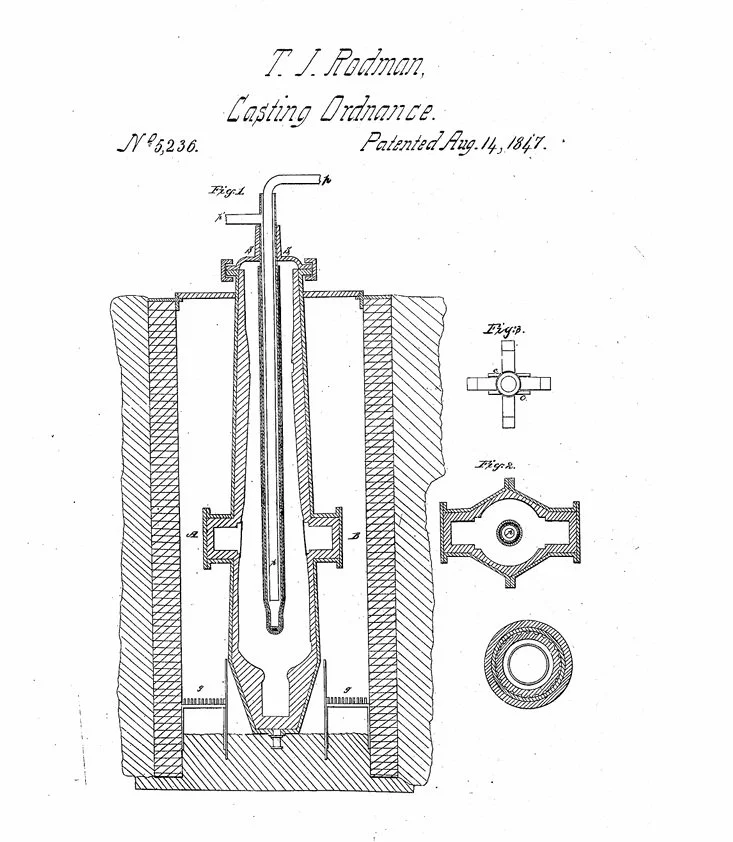
Mike Ryan’s excellent paper summarizes Rodman’s theory:
In the traditional solid casting process: “the outer layers of the guns cooled first becoming solid while the interior of the casting remained fluid. Gradually as the inner layers cooled and contracted, the outer solid crust was unable to follow the contraction of the inner mass. As a result, the interior became solid in a state of high tension. Under these circumstances, the potential for developing flaws, cracks, and cavities in the interior of the gun - the area which required the greatest strength - was considerable. And since the frequency and severity of these flaws merely increased with the size of the casting, there was a practical limit to the size of gun which could be cast solid and still be considered safe enough to resist the strain of firing.
By 1847 Rodman had developed his theory of hollow casting. As part of this process, when the metal cooled, cold water was pumped through the core of the mold located inside the bore. As the water circulated and carried off the heat of the casting, the tube cooled from the inside out, the reverse of what occurred during the traditional method. And with the Rodman process the metal no longer pulled itself apart as it cooled; instead the interior of the tube cooled first, and as the outer layers progressively cooled and contracted, they clamped down and helped to strengthen the interior of the tube.” (Ryan, pg 25; Also see Rodman’s patent US5236A).
Though Rodman could not convince his superiors in the Army to adopt the new method, he received permission to work on his own with private industry to try his ideas. In 1847, Rodman received a patent for his new process, and he and Charles Knap of the Fort Pitt Foundry attempted the process - “an experiment believed fraught with the very real danger of burning down the plant” (Ripley, pg 78.)
Beginning in 1849, Rodman conducted a series of trials pitting 8-Inch and 10-Inch Columbiads cast solid against those cast hollow according to his principles. The six solid-cast guns endured 772 rounds altogether before bursting, while the hollow-cast guns fired 5,515 rounds, and remained intact. (Birkhimer, pg. 283-284).
Chart showing the pressure within a 42-pounder from the breech of the tube (left) to the muzzle. From Benton.
Rodman also continued a line of study begun by Colonel George Bomford in the 1840s. Bomford drilled small holes in a cannon perpendicular to the gun’s bore. He placed a small steel ball each hole and measured the force with which they were expelled. Rodman’s version of the experiment used small steel punches driven into sheets of soft copper - the depth of the indentations giving an idea about pressure. These measurements created a graph which showed that the pressure of the firing gun was greatest only a little ahead of the seat of the charge and dropped off rapidly towards the muzzle. (Benton, pg. 152-153).
Whereas traditional cannon tapered only gradually from breech to muzzle, Rodman realized that a cannon needed to be very thick at the breech but could taper rapidly. His design mirrored the work of John Dahlgren who designed his own series of “soda bottle” shaped guns for the Navy, and the two inventors eventually accused each other of plagiarism - though it may be that both were taking Bomford’s experiments to their logical conclusion. However, Dahlgren initially designed all of his guns to be cast solid (Schneller, pg. 206-208). The strong resemblance between Dahlgren and Rodman guns continues to be a source of confusion among those interested in American Artillery of the Civil War.
A 10-Inch Confederate Columbiad being lifted from its carriage at Fort McAllister near the end of the war. The Confederate Columbiad adopted Rodman’s breech design.
The most obvious difference between Dahlgrens and Rodmans is at the breech. Whereas Dahlgren’s guns include a cascabel designed to take both a heavy breeching rope and an elevating screw for naval service, Rodman’s guns have a flat breech with a grove just ahead of the breech. The groove is to take a rope when the piece is lifted. Rodman found that the small cascabels on previous designs were prone to breakage when subject to the weight of the entire gun. With Rodman’s design, there was a secure channel for the rope supporting nearly the full thickness of the breech (Olmstead et al., pg. 75).
The earliest Rodmans had ratchets on their breech, but most produced have sockets for use with a post on the carriage and a lever. Both systems allowed for the gun to be elevated through a wide range but also finely controlled for precision fire (Olmstead et al., pp. 75-76).
US Army 8-Inch Rodmans at Fort McHenry with a 15-Inch Rodman in the Background
The smallest of Rodman’s guns, the 8-Inch, weighed about 8,500 pounds. It fired a 64-pound shot or a 50-pound explosive shell with a 10 pound propellant charge.
The 10-Inch weighed just over 15,000 pounds. It fired a 125-pound shot or a 100-pound explosive shell with a 15 pound propellant charge.
These two Rodman guns supplemented and then replaced Columbiads of the same calibers in US Army service beginning in 1861.
Rodman’s methods allowed for far larger guns to be cast, by far the most numerous of these was the 15-Inch which weighed around 50,000 pounds. It fired a solid shot weighing up to 440 pounds and shells of around 330 pounds with a 50 pound propellant charge (See tables in Benton, pp. 520-521).
All three were capable of handling far heavier propellant charges - by the 1880s the 15-Inch was approved for a 100 pound charge and the 10-Inch for a 25 pound charge (Tidball, pp. 108, 119).
Illustration of the newly cast prototype 15-Inch Rodman, then called the “Floyd Gun” but later named “The Lincoln Gun”
The first 15-Inch Rodman was cast in January 1860 at Fort Pitt Foundry. Frank Leslie’s Illustrated Newspaper reported that the enormous casting mold was placed in a pit thirty feet deep and ten feet across. It took two huge furnaces with a combined capacity of thirty one tons of iron to pour the molten metal into the mold. At the time of its production, it was the largest gun in the world (Leslie’s February 25th, 1860, pp. 195-196).
The Lincoln Gun now at Fort Monroe
The resulting prototype 15-Inch Rodman was taken to Fort Monroe to be used by the garrison against CSS Virginia, but the ironclad never came into range of the massive gun. It still survives and is displayed at Fort Monroe. Though it was originally nicknamed the “Floyd Gun” after the the Secretary of War when it was cast in 1860, it was renamed the “Lincoln Gun” in 1862. It survives on the parade ground at Fort Monroe (National Park Service article.) According to the historical marker beside the preserved gun, it was used to fire on Confederate batteries at Sewell’s point.
During the Battle of Hampton Roads, the 11-Inch Dahlgren guns carried aboard USS Monitor failed to break through the armor of CSS Virginia. In the aftermath of the battle, Assistant Secretary of the Navy Gustavus Fox saw the Lincoln gun at Fort Monroe. In the massive weapon he saw a way that Virginia and ships like her could be defeated. Soon, the US Navy’s Chief of Ordnance, John Dahlgren, was ordered to develop a 15-Inch Gun for the Navy.
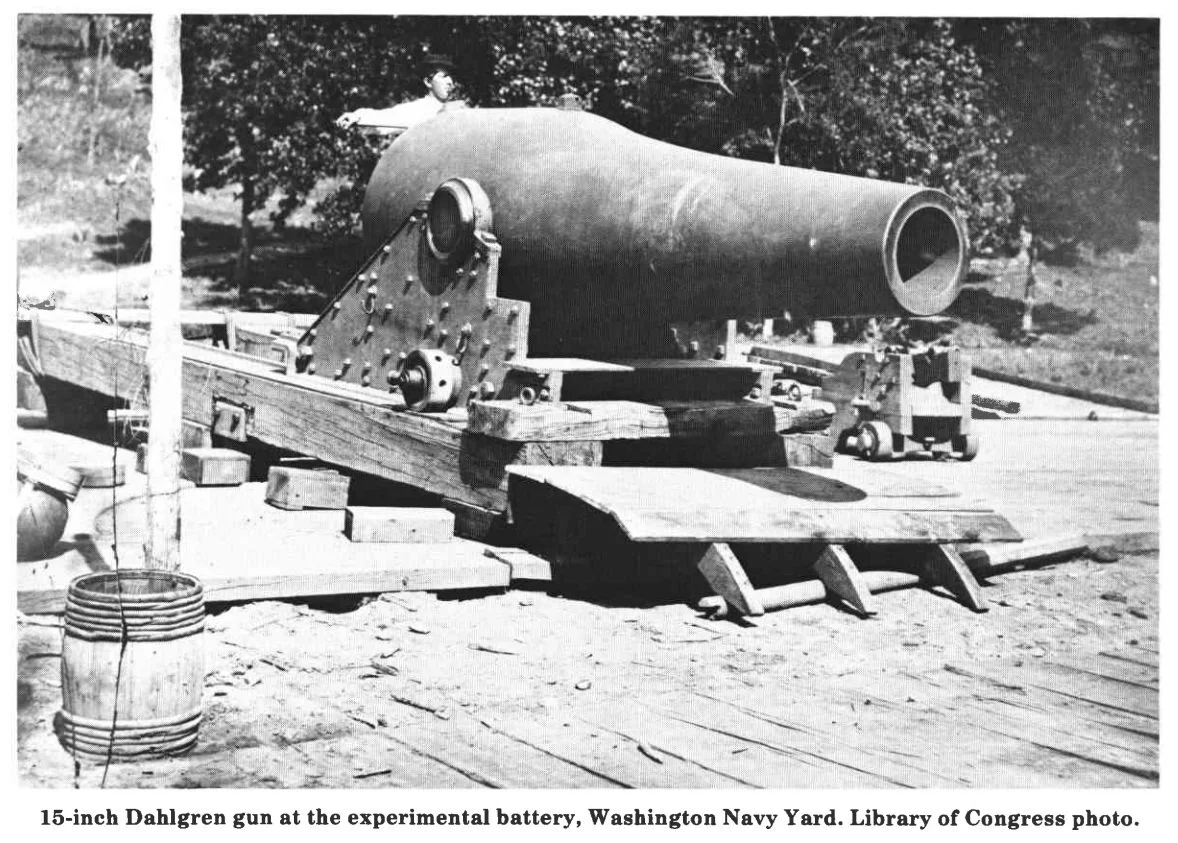
15-Inch Dahlgren at the Washington Navy Yard during the Civil War
The 15-Inch Rodman was too long for use in turrets of the Passaic-class which followed USS Monitor into service. Dahlgren designed a short 15-Inch adapted for Navy service which would fit into Passaic-class turrets. As Rodmans were the only guns of this size ever successfully produced, Dahlgren agreed that the Navy 15-Inch guns should be manufactured using Rodman’s hollow casting technique (Schneller, pp. 201-225).
The Navy 15-Inch gun would go on to quickly knock out CSS Atlanta in her battle with USS Weehawken. USS Manhattan’s 15-Inch guns broke through CSS Tennessee’s heavily armored casemate. And the 15-Inch guns of the US Navy’s South Atlantic Blockading squadron played a significant part in reducing Fort Sumter to rubble. Dahlgren, eventually very hesitant to put his name to this 15-Inch gun which had been rushed into service, was very quick to claim the plaudits for the victories associated with it.
On my page I usually refer to the Navy 15-Inch as a Dahlgren, but some period accounts referred to it as a Rodman - without Rodman’s technique, they would likely have gone to pieces.
In any event, the Navy’s 15-Inch guns saw far more combat use than those of the Army. If the Lincoln gun indeed fired across Hampton Roads at the Confederates, that may have been the only combat use of the Army’s 15-Inch guns.
8-Inch, 10-Inch, and 15-Inch Rodmans began to fill the batteries of forts guarding northern harbors. Because the Confederate Navy never mounted a serious threat to these harbors - and because diplomacy kept foreign powers out of the war, almost no Rodman gun ever fired a shot in anger (Ripley, pg. 80). Surviving photos and accounts of siege operations at Charleston, Yorktown, and elsewhere show that the US Army preferred heavy Parrott rifles for their accuracy at long range over the far more reliable Rodman smoothbores.
8-Inch Confederate Columbiad in St. Augustine, Florida: https://www.santee1821.net/preserved-artillery/8-inch-confederate-columbiads-in-st-augustine-florida
Though Rodman’s guns were not used in combat, guns based on his design very much were. By the end of 1861 both Tredegar Ironworks and Bellona Foundry near Richmond were producing 8-Inch and 10-Inch Columbiads which were visually quite similar to Rodman’s guns. They shared the same breech design as well as the overall shape. With the 8-Inch, in particular, it can be difficult to distinguish the southern from the northern version at first glance. Two 8-Inch guns manufactured with short trunnions survive at St. Augustine - only their Bellona Foundry markings give them away as Confederate guns.
The Confederacy did not have enough iron to spare to make iron carriages - so the Confederate guns, aside from the two in St. Augustine, have longer trunnions for wooden carriages. The Confederate 10-Inch gun is also about 13 inches shorter and therefore about 1,700 pounds lighter than its Yankee cousin. The slightly shorter barrel was ballistically insignificant with a black powder gun, and the smaller amount of iron that was needed to produce it stretched the thin resources of the Confederacy just a bit farther. The Confederate guns also received only the lathe work necessary for service. They have a rough “war emergency” appearance, but they worked. Up to about 65 8-Inch Columbiads and 140 10-Inch Columbiads were produced by the two Richmond foundries for the Confederacy (Olmstead et al., pg 66. Ryan, pg. 21).
10-Inch Confederate Columbiad at Fort Moultrie
The 10-Inch Confederate Columbiad was among the most powerful guns to arm Southern forts. Only the heaviest Brookes were clearly superior to it, and Brookes, most of which were rifled and all of which received wrought iron reinforcing bands, were more labor intensive to produce. The 10-Inch Columbiads were placed in forts guarding the most critical harbors and waterways, and therefore they regularly fought ships of the US Navy. Although they were not sufficiently powerful to punch through the armor of a US Navy monitor, they were able to disable monitors and force them to withdraw after a number of hits, and almost all of the Navy’s combat veteran monitors bore the scars inflicted by Confederate 10-Inch guns through the rest of their careers.
These 8-Inch and 10-Inch guns are sometimes called Confederate Rodmans. I don’t use that term. None of them were cast using Rodman’s hollow casting technique. Two 12-Inch guns were cast hollow by Tredegar in the last months of the war, but neither seems to have been completed (Olmstead et al., pg. 66.)
Something like 200 8-Inch Rodmans were eventually produced for the US Army alongside 1,291 10-Inch Rodmans and 322 15-Inch Rodmans. Hundreds of guns were produced during the war, but production continued apace through 1867. Additional orders for the 15-Inch Model were placed in 1871 with the last gun cast in 1872 (Olmstead et al, pp. 76-78, 262-264).
15-Inch Rodman Gun mounted at Battery Rodgers in Alexandria, Virginia
Almost all of the hundreds produced during the war were placed in forts far from the front lines guarding against a contingency that seemed remote after the crisis with CSS Virginia passed. A few, like the one placed at Battery Rodgers in Alexandria or its mate mounted across the Potomac river at Fort Foote, may have guarded against a theoretical possibility that the James River Squadron of the Confederacy might sortie and ascend the Potomac if the US Navy was drawn away from Hampton Roads, but that possibility was remote.
And the chance that the dozens and eventually hundreds guarding northern cities would be called upon to fight was yet more remote - especially after diplomatic efforts squashed the construction of ironclads for the Confederacy in Europe - well, save for CSS Stonewall.
It says quite a lot about the enormous chasm in industrial capacity between North and South that the Union managed to produce hundreds more heavy guns than the Confederacy with many of these being 15-Inch guns which were really in a different class than the 10-Inch… and almost all of this enormous production was for a pretty slight contingency whereas every single 10-Inch Confederate gun was an important asset placed with care in the most critical areas.
20-Inch Rodman at Fort Hamilton, New York https://www.santee1821.net/preserved-artillery/20-inch-rodman-of-fort-hamilton-new-york
And in 1864 Fort Pitt Foundry cast an enormous 20-Inch Rodman gun. A contemporary illustration shows the size of the casting-flask required for this monster beside that used for an 8-Inch Rodman. An 8-Inch Rodman is not a small gun. The 20-Inch is on a completely different scale.
In Artillery and Ammunition of the Civil War, Warren Ripley writes of the 20-Inch Rodman, “Mounted at Fort Hamilton, New York, the piece was fired only a few times since no target could be found sufficiently tough to resist the impact of 1,080 pound solid shot propelled by 100-pound service charges. It was fired four times after mounting and four more in 1867. The latter practice, with 125 pounds of powder, gave a range of 6,144 yards and with 200 pounds, 8001 yards. Elevation in both instances was 25 degrees” (Ripley, pg. 80).
This 20-Inch Rodman, Registry Number 1, survives at Fort Hamilton, New York and is displayed on the upper portion of its carriage. It is marked as weighing 116,497 pounds.
A second 20-Inch was cast in 1869. It was the gun displayed at the Centennial Exposition in Philadelphia. Later Number 2 was taken to Sandy Hook where it remains on display (National Park Service article).
Although no new Rodmans were cast after 1872, work did not cease on the Rodman system. Photos of the Centennial Exposition display show breechloaders based on Rodmans.
By far the most consequential work, though, was on a project to convert 10-Inch smoothbores to 8-Inch rifles. A few rifles had been made from Rodmans during the Civil War. One 15-Inch block was bored to 12-Inches and rifled, but none of these early rifles were thought successful.
By the 1870s it was clear that smoothbore guns did not have the range necessary to be effective against modern armored ships. In essentially the same process as later adopted by the US Navy to convert an 11-Inch Dahlgren to a 8-Inch Rifle, the 10-Inch Rodman was bored out to 13.5-inches and an 8-inch wrought iron sleeve was inserted into the old cast iron tube and locked in place with a threaded ring at the muzzle. The first series of these conversions were undertaken at West Point Foundry and South Boston Foundry from 1876 to 1879 (Olmstead et al., 78-79).
The Navy reckoned that their conversions were 25% more effective at the muzzle and twice as much at 1,000 yards than the old smoothbores. (Secretary of the Navy Report for 1877, pg. 128). Army tests found that the converted rifles, firing a 180 pound projectile with a 35 pound propellant charge could penetrate 7.42 inches of iron armor at 1,000 yards (Tidball 1884, pg. 133).
Illustration of the 8-Inch Rifle Conversion using the Muzzle Insertion Method
In the 1875 report of the Chief of Army Ordnance stated:
Our trial thus far with a 10-inch Rodman gun lined with wrought iron and converted into an 8-inch rifle gives promise of success; and another lined with steel,now nearly ready for firing, may probably give equal, if not better, results. This 8-inch rifle has already been fired 328 rounds,* with battering-charges of 35 pounds of powder and 180-pound shot, giving an average velocity of about 1,425 feet, and a working energy of nearly 5,000,000 foot-pounds; capable of penetrating seven inches of iron armor at distances from 500 to 1,000 yards. This success enables us at comparatively small cost to utilize the 1,294 10-inch smooth-bore guns, which as smooth-bores are utterly useless against ironclads, by converting them into 8-inch rifles capable of penetrating 7 inches of iron armor.
The value and interest of this proposed conversion is all the greater from the fact that the casemates of our forts, designed many years since, are too contracted to accommodate a gun of much larger size than the 10-inch Rodman; and this very gun intended for that special purpose can thus be strengthened and increased in power, to meet the greater demands that modern improvements in naval attack and defense make upon it.
https://babel.hathitrust.org/cgi/pt?id=coo.31924069849952&seq=143
Like the US Navy which saw such conversions as a way to get use out of ships built for earlier guns, the US Army saw the conversion of Rodmans both as economically expedient and also as a drop-in upgrade for existing fortifications which had been built at significant expense.
Illustration of the “Breech Insertion” 8-Inch Rifle Conversion
The second series of conversions bored through the breech of the gun. This enabled the use of a steel sleeve that was thicker in the breech area. A rectangular knob attached to the breech plug and presumably used to tighten all of these pieces together sticks out from the breech. A surviving carriage in Massachusetts shows that the converted rifle was elevated using a gearing mechanism.
1875 Report; https://babel.hathitrust.org/cgi/pt?id=coo.31924069849952&seq=141
See: US Army “Report of the Chief of Ordnance” for 1884, Appendix 21 beginning on page 244 for a detailed report on trials of the 8-Inch Rifles. https://babel.hathitrust.org/cgi/pt?id=uc1.b2979322&seq=324
1883 Test against Armor : https://babel.hathitrust.org/cgi/pt?id=uc1.b2979321&seq=439&q1=insertion
The last series of 8-Inch Conversions returned to a muzzle insertion method with the last of the conversions completed circa 1886 (Olmstead et al., 79).
Rodman guns, supplemented by a smaller number of Parrott Rifles, were the armament of US Seacoast defences through the 1880s into the 1890s.
When the US Army began to restore, repair, and modernize southern forts in the 1870s, Rodman guns were a significant part of that effort. Fort Moultrie on Sullivan’s Island, South Carolina is a great example. Two enormous 15-Inch Rodmans are displayed in the fort. The guns are original, though the carriages are replicas made in the 1970s.
Many of these old guns were manned again at the time of the Spanish American War as civilians wanted to know that the Army was doing something to protect them, however, the Rodman era - and the era of muzzle loading, cast iron guns was truly gone as rifled, steel, breechloading guns of tremendous range and power had become standard in the navies of the world.
10-Inch Rodman in Middlebury, Vermont: https://www.santee1821.net/preserved-artillery/10-inch-rodman-of-middlebury-vermont
Many Rodman guns: 8-Inch, 10-Inch, and 8-Inch Rifles survive as monuments.
Communities began erecting monuments to fallen soldiers - and eventually all veterans - in the years following the American Civil War. Major cities and wealthy communities could afford massive stone pillars with bespoke sculptures in bronze and marble by noted artists. Rural county seat towns might have a simple pillar with a mass-produced statue of a generic soldier, but even these more humble monuments were beyond the means of many communities. On May 22nd, 1896 an Act of Congress of provided that any G.A.R. Post, other veterans organization, or memorial committee could apply for an obsolete cannon from the Army or Navy. The only cost would be that of shipping the cannon and installing it upon an appropriate pedestal. Thousands of cannons were donated by the government to communities. Some were placed to augment an existing monument, but for many small communities, veterans organizations, and cemeteries, the cannon - with a small dedication plaque - was the monument.
Other Rodmans survive where or near they were mounted in US Army forts.
In some instances they were left in place as monuments - the three Rodmans, one an original 10-Inch and two 8-Inch Rifle conversions at Fort Monroe are an example.
The plaque on the 10-Inch at Fort Monroe states that it was nicknamed “The Lovers Gun” as it was in the last casemate of the water battery - a secluded spot where soldiers and their sweethearts might find a bit of privacy.
15-Inch, 8-Inch, and 8-Inch Rifle Rodmans are displayed at Fort McHenry in Maryland
Fort McHenry is probably the best place to see the Rodman system of the US Army. While almost every fort had almost all of their Rodmans taken away for scrap (or donated as memorials), the fort whose heroic defense in 1814 had been the inspiration for the "Star Spangled Banner" kept its battery of Civil War era Rodmans. They fired salutes on the 4th of July for years. As a result, visitors today find five of the giant 15-Inch Rodmans along with alongside 8-Inch Rodmans and the 8-Inch Rifles (which were conversions of 10-Inch Rodmans).
In a number of other cases, particularly with 15-Inch Rodmans, it seems like they were simply too much trouble to move for scrap - especially those guns located in more remote forts. The 15-Inch Rodmans at Fort Sumter, Fort Moultrie, and Fort Jefferson seem to have had their carriages disassembled and taken away for scrap while the guns themselves remained - and were sometimes just buried.
In other cases, Rodmans were used as fill in the construction of more modern batteries of the Endicott System. At Fort Zachary Taylor at Key West, you can see Rodmans embedded in the concrete of the newer battery. Also at Fort Taylor are other Rodman guns which were just left in place as the casemates they were in were filled with sand. 20th Century Excavations now let us see these guns.
Replica Rodmans at Fort Clinch in Florida: https://www.santee1821.net/ships-forts-and-technology
Other forts, like Fort Clinch in Florida, have created replicas of Rodmans. Fort Clinch has quite a number of these replicas that pass all but the closest inspection. The replicas help visitors get a sense of how the fort was armed in a way that is a lot more impactful than a sign and a series of empty gun emplacements.
Thomas Jackson Rodman’s guns remain as testaments to both the capabilities and limitations of US Ordnance in the 19th Century. When displayed at historic forts, they become an integral part in telling the story of the soldiers who served there, and when displayed as monuments in cemeteries, town squares and courthouse lawns, they memorialize all the soldiers, sailors, and marines of our nation.