The Armament of USS Enterprise, 1877 to 1895
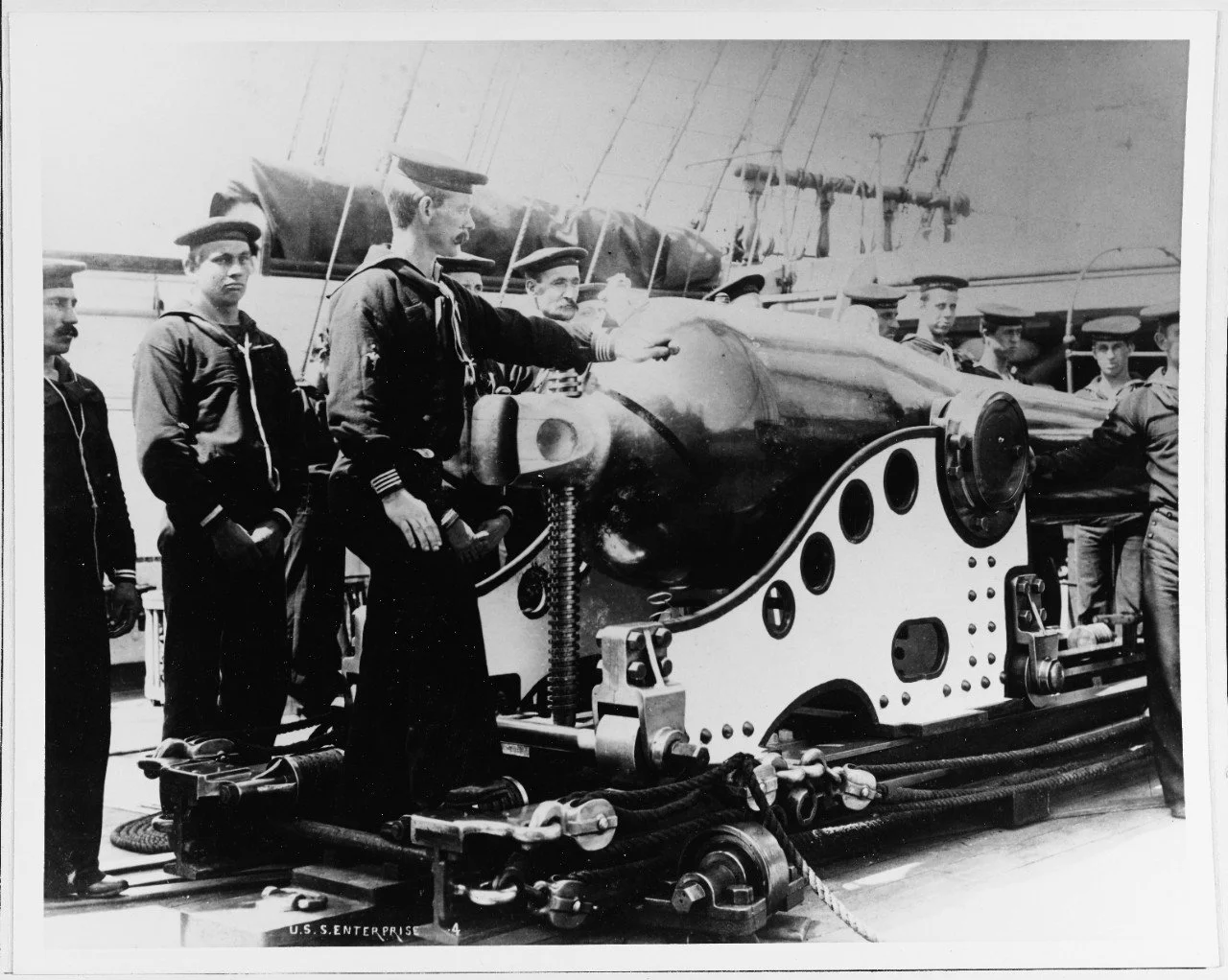
Photo Above: 8-Inch Muzzle Loading Rifle of USS Enterprise in the 1880s or early 1890s. Naval History and Heritage Command Photo NH 66468
Although the name “USS Enterprise” is associated with some of the US Navy’s most famous and powerful ships today, the Enterprise which served the US Navy during the 1870s and 1880s was a wooden hulled “3rd Class Steamer”, a type frequently called a gunboat. At 185 feet long, 35 feet on the beam, and 1,370 tons displacement, she was one of the smallest ships in the fleet serving as an active cruiser. She was still capable of long distance voyages, and was significantly larger than ships built during the Civil War carrying a similar armament.
While Enterprise is a single ship, her armament and its changes between 1877 and 1891 are very representative of the United States Navy as a whole. While larger ships may have carried more guns, they generally carried guns of the same type as Enterprise during this period.
During the American Civil War, ships of the US Navy carried over a dozen different models of heavy gun, by the last days of the Old Steam Navy, a review of logbooks from the early 1880s shows that only three types were commonly carried in the active fleet:
The 8-Inch Muzzle Loading Rifle: The 8-Inch MLR (preserved examples) was a conversion of an 11-Inch Dahlgren smoothbore and it served as a “drop in upgrade” for ships built to carry the Dahlgren. The original smoothbore was bored out to 13.5-inches to accept an wrought-iron rifled sleeve 8-Inches in caliber. It fired a 180-pound projectile with an up to 35 pound propellant charge. By the early 1880s almost every active cruising ship carried one or two as pivot mounts. Only USS Trenton and USS Lancaster carried uniform batteries of ten of the type.
The 60-Pounder Breech Loading Rifle: The 60-Pounder BLR (preserved examples) was also a conversion. In this instance a 60-Pounder Parrott Rifle (a muzzle loader) had its breech removed and a steel sleeve inserted from the breech which had an interrupted screw breech block. Most ships in the fleet carried one of this type on their forecastle on a directing bar pivot carriage. It fired a 40 to 50 pound projectile with a 5 to 6 pound propellant charge.
The 9-Inch Dahlgren Smoothbore: The 9-Inch Dahlgren (preserved examples) was introduced to the fleet in the 1850s. It provided good service during the American Civil War, but by the early 1880s it was of very limited utility - firing a 90 pound shot or 73 pound shell at low velocity and with limited range. Despite this, it was the type carried in the largest numbers afloat. Enterprise carried four. USS Hartford, a much larger ship, carried twelve - the only significant difference in armament between the two ships. They were mounted on broadside carriages which except for the iron construction would have been recognizable to sailors of the previous century.
Other types were in active service. 15-Inch Dahlgrens were carried aboard war-built monitors, a few of which were in limited service as harbor defense vessels. 11-Inch Dahlgrens were being replaced by the 8-Inch MLR starting in 1877 but could still be found aboard a few ships. A small number of 80-Pounder Breech Loading Rifles (a conversion of the 100-Pounder Parrott) were in service aboard two or three ships. 8-Inch and 32-Pounder smoothbore shell guns were aboard auxiliary vessels such as training ships, supply ships, and some smaller non-combatant ships.
Comparative Armament of US Navy Vessels - Circa 1883
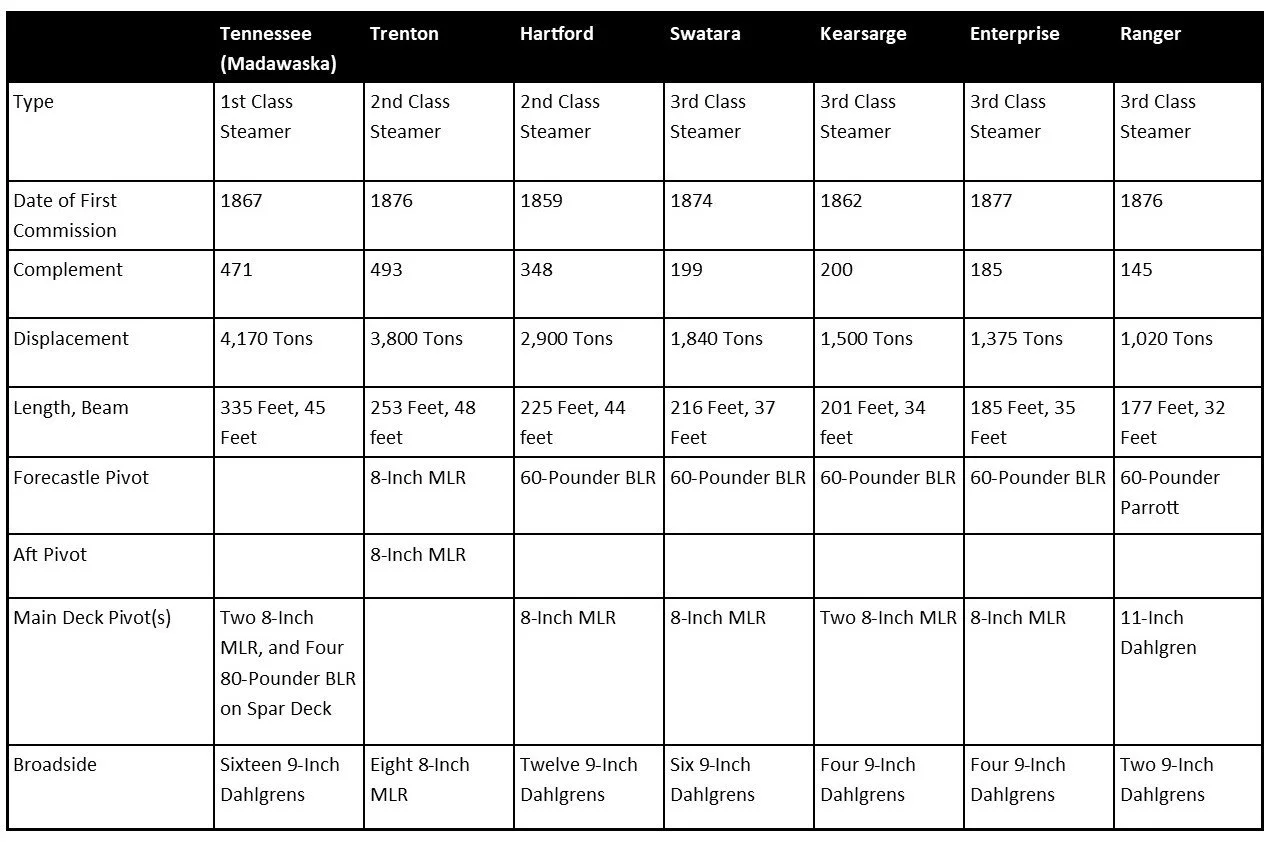
Details in table above regarding armament taken from US Navy Logbooks, Bureau of Ordnance “Register of Naval Guns”, Report of the Secretary of the Navy for 1875, and Donald Canney’s “Old Steam Navy: Frigates, Sloops, and Gunboats”, and the Dictionary of American Naval Fighting Ships. As specifics are sometimes slightly different in the above sources, the information should be taken as a close approximation.
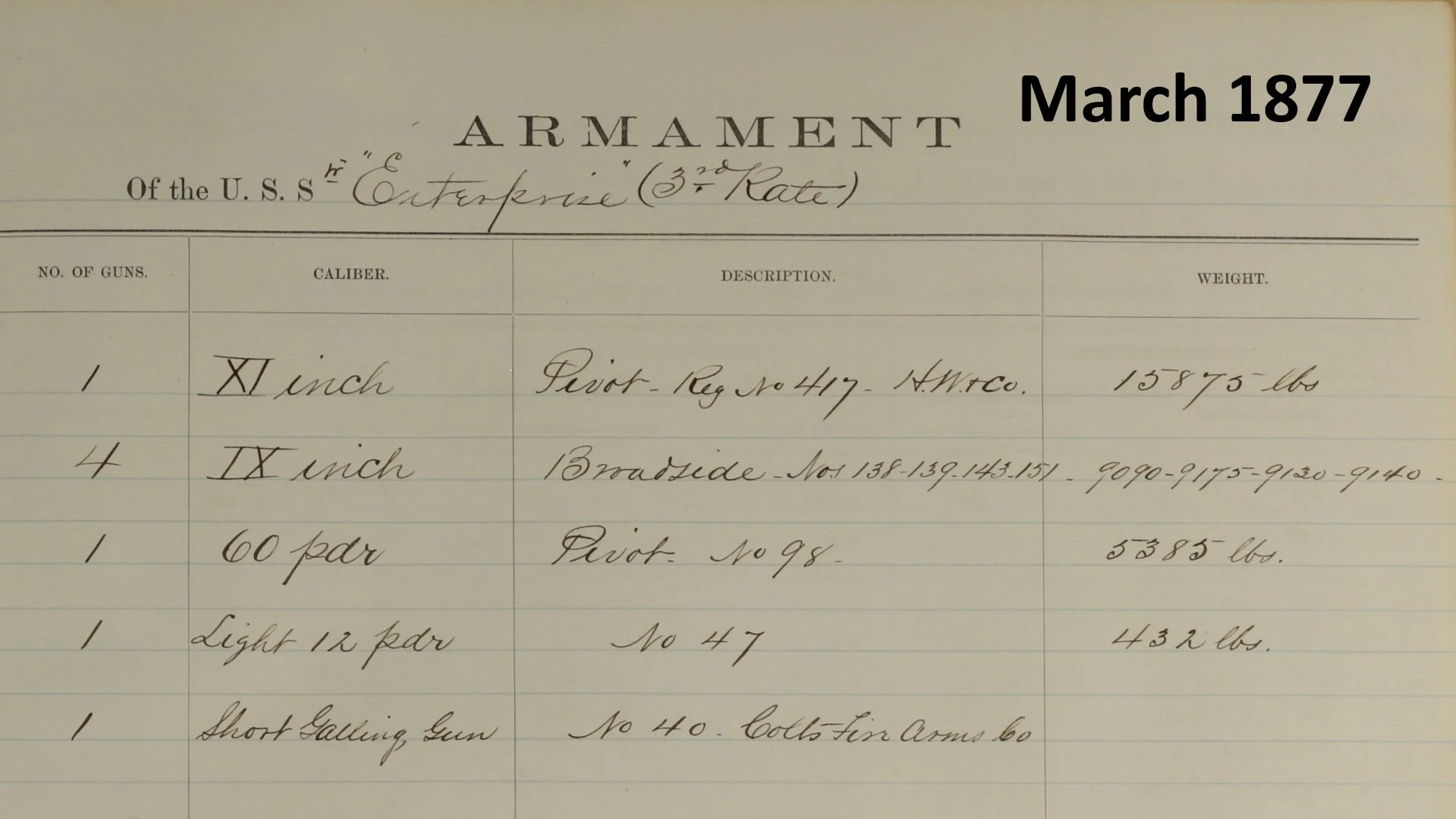
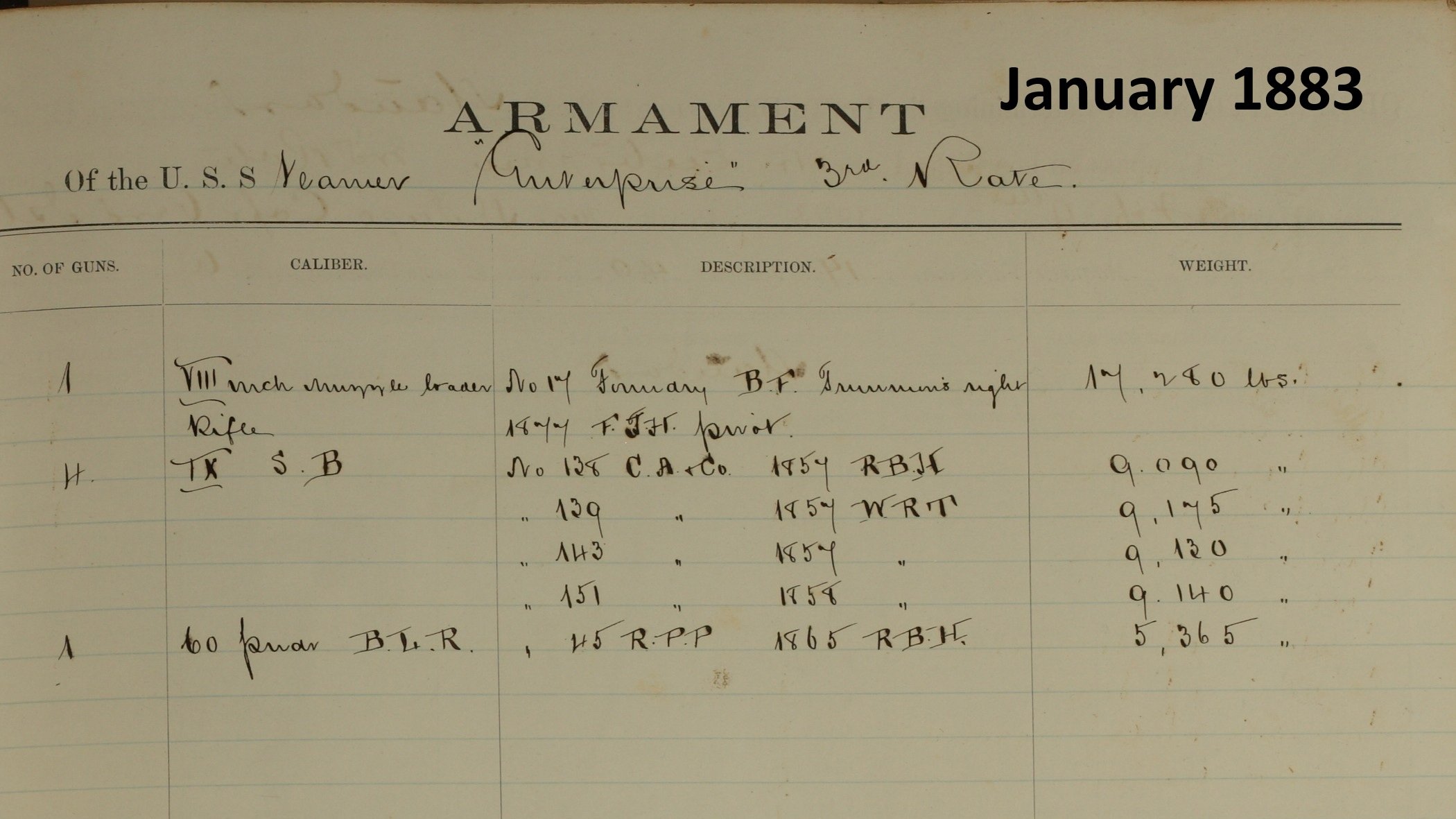
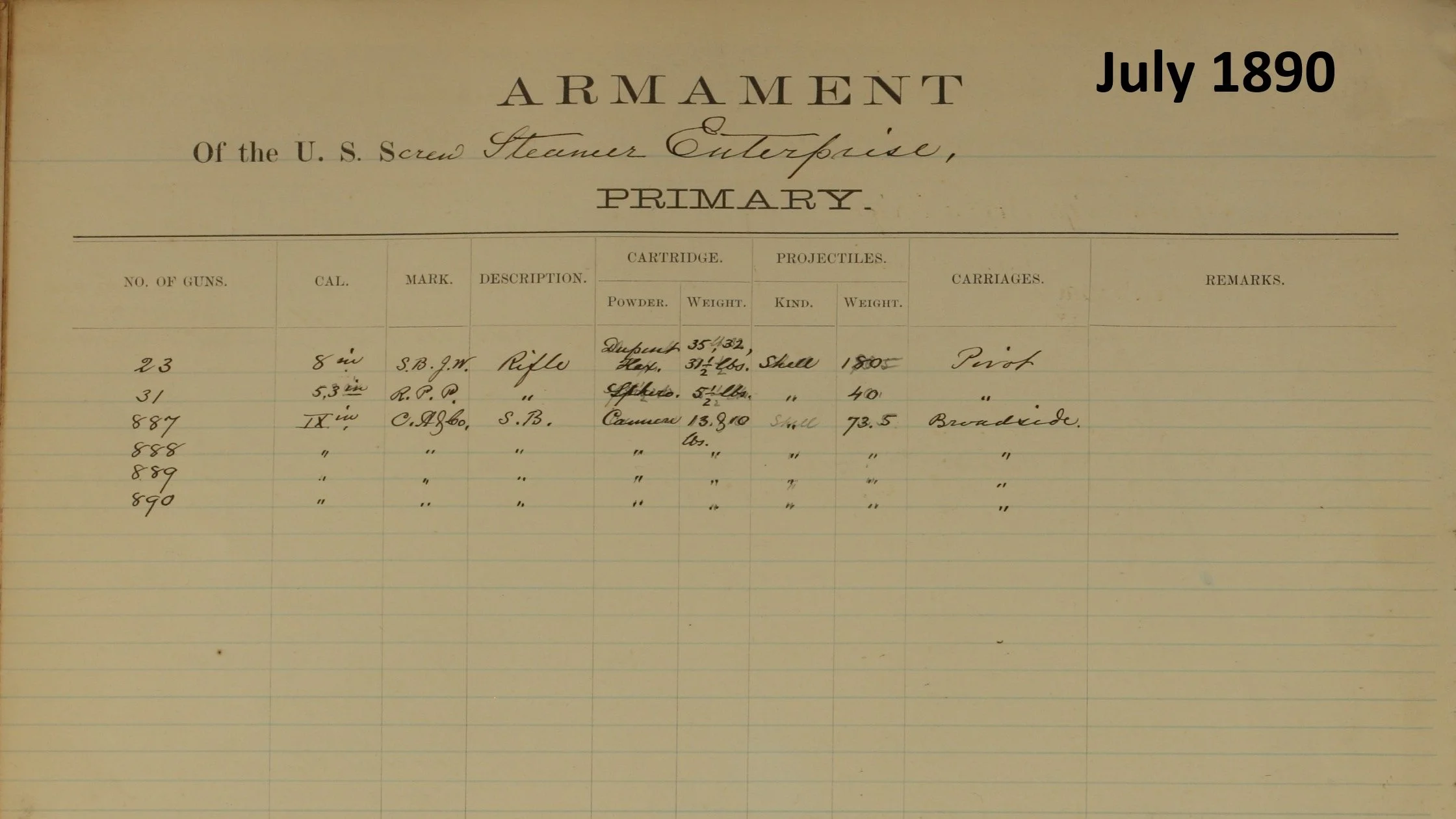
USS Enterprise - Primary Armament in 1877, 1883, and 1890
Below are images of the Armament Page from Enterprise’s logbooks showing the armament at three points in her career. The main changes are a the replacement of the 11-Inch Dahlgren carried in her first commission by an 8-Inch Muzzle Loading Rifle for her 1882 commission and the replacement of the original 60-Pounder Parrott by a 60-Pounder BLR, again in 1882. The specific 9-Inch Dahlgrens were also changed between 1883 and 1890 but were otherwise identical. Images taken from: https://www.archives.gov/research/military/logbooks/navy-online-thru-1940
The National Archives does not have logbooks from Enterprise’s years as a training ship of the Massachusetts Maritime Academy. It seems as if Enterprise carried four or six 32-Pounders of 4,500 Pounds in at least her first years as a school ship.
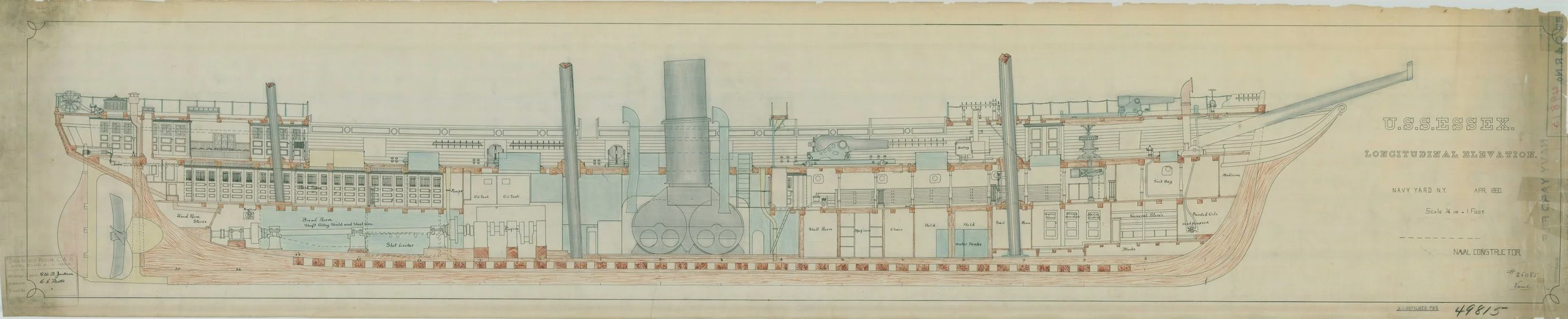
USS Enterprise - Layout
A longitudinal elevation of USS Essex (sister ship of Enterprise) show’s the arrangement of the class. The 60-Pounder BLR is shown on the forecastle. The 8-Inch Muzzle Loading Rifles is shown amidships on the main deck. The two pairs of 9-Inch Dahlgrens are aft of the main mast.
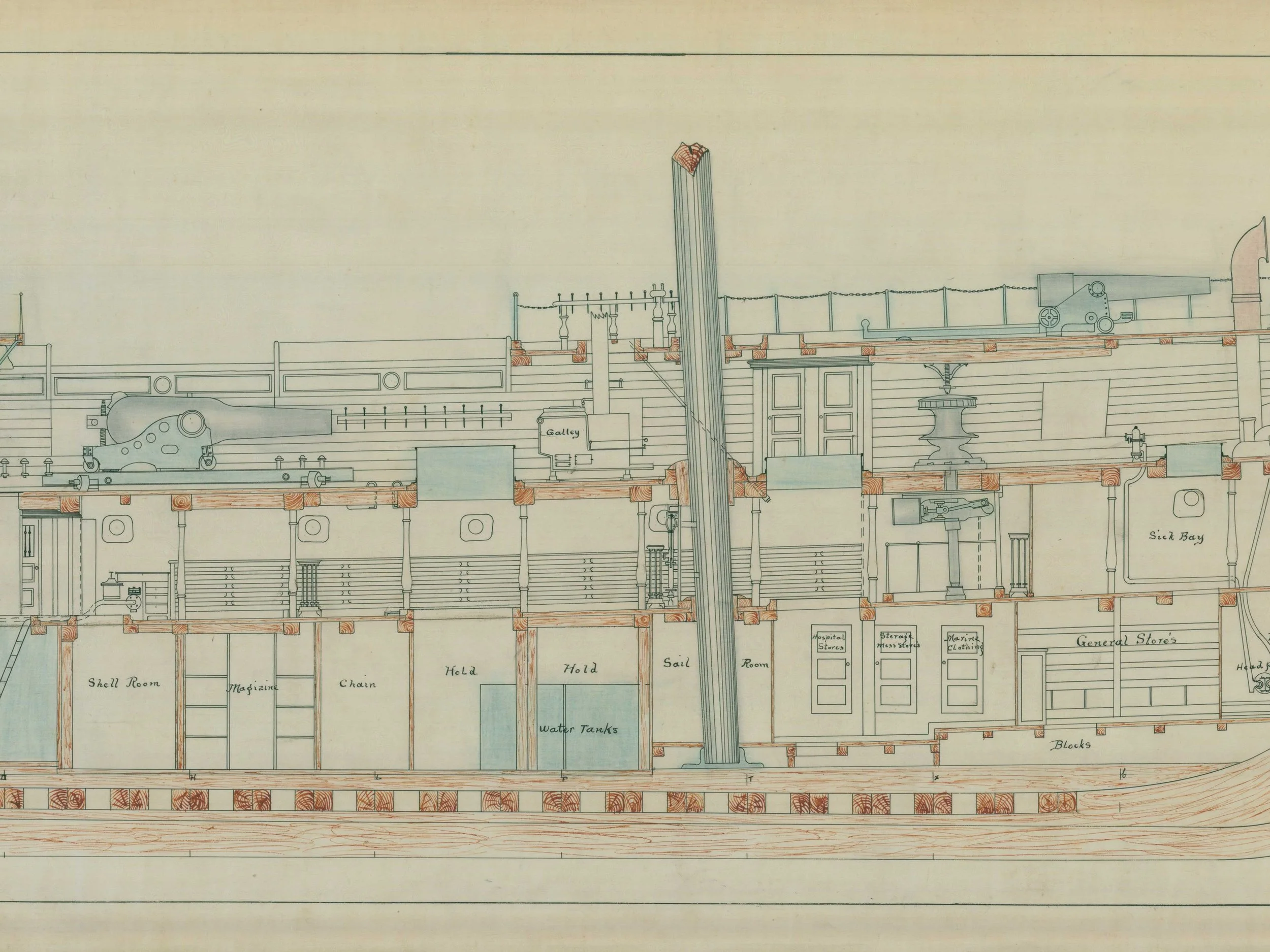
Detail of USS Essex Longitudinal Elevation: Note the 8-Inch MLR (left) and 60-Pounder BLR on the forecastle. From: https://catalog.archives.gov/id/158704355
The US Navy 8-Inch Muzzle Loading Rifle
Originally equipped with an 11-Inch Dahlgren (Number 417 which survives in Bangor, Michigan), USS Enterprise was refitted with an 8-Inch Muzzle Loading Rifle in 1882. As the logbook entries above show, the original 8-Inch Rifle was Registry Number 17. Prior to 1890, it was replaced with Registry Number 23.
Like the similar US Army program, the US Navy sent existing cast-iron 11-Inch Dahlgren cannons back to the foundry where their barrels were bored out to 13.5 inches. Separately, a new 8-Inch rifled inner barrel (called a “sleeve”) was made of wrought-iron bars machine hammered together. This sleeve fit into enlarged bore of the old cast-iron cannon. The result was a cannon that (it was hoped) combined the metallurgical strengths of both wrought-iron and cast-iron in a size and shape that was familiar to the sailors of the US Navy and fit upon existing ships and carriages. The program was also intended to be less expensive than producing or purchasing wholly new modern cannons.
The newly converted rifled cannon would fire a slightly heavier projectile greater range, accuracy and power than the old smoothbore. (The old 11-Inch smoothbore fired a round shot weighing about 165 pounds or a shell weighing about 132 pounds. The new 8-Inch projectile was smaller in diameter but much longer and weighed up to 180 pounds.) The 8-Inch also used a heavier service charge - up to 35 pounds of propellant vs. up to 30 pounds for the 11-Inch smoothbore. See 1880 Service Charges.
1880 US Navy Ordnance Instructions describe a “Battering Shell” weighing 180 pounds with a base fuse and a small bursting charge and a “Common Shell” also weighing 180 pounds with a nose fuse and a larger bursting charge.
The 1877 report of the Chief of the Bureau of Ordnance of the Navy stated that, “Ten 11-inch smooth-bores have been finished and twenty are in process of conversion to 8-inch muzzle-loading rifles by the approved method of lining with a wrought iron tube. This conversion adds 25 per cent to the power of the gun at the muzzle and doubles it at 1,000 yards. The increased recoil required alterations in the carriage for its efficient control, which have been devised and answer well the purpose.”
An 1877 article in Proceedings and 1880 text book for students at the Naval Academy offer much more detailed descriptions of the conversion process.


Photo above shows the muzzle of an 8-Inch MLR. The inner sleeve (painted red) is joined to the outer cast iron barrel by means of the threaded ring (center). Photo shows 8-inch MLR Number 50 of USS Lancaster in Mount Pleasant, South Carolina

Photo above shows US Navy 8-Inch Muzzle Loading Rifle, Registry Number 32, in Lambertville, New Jersey. It is mounted on a carriage similar to that carried aboard USS Enterprise.
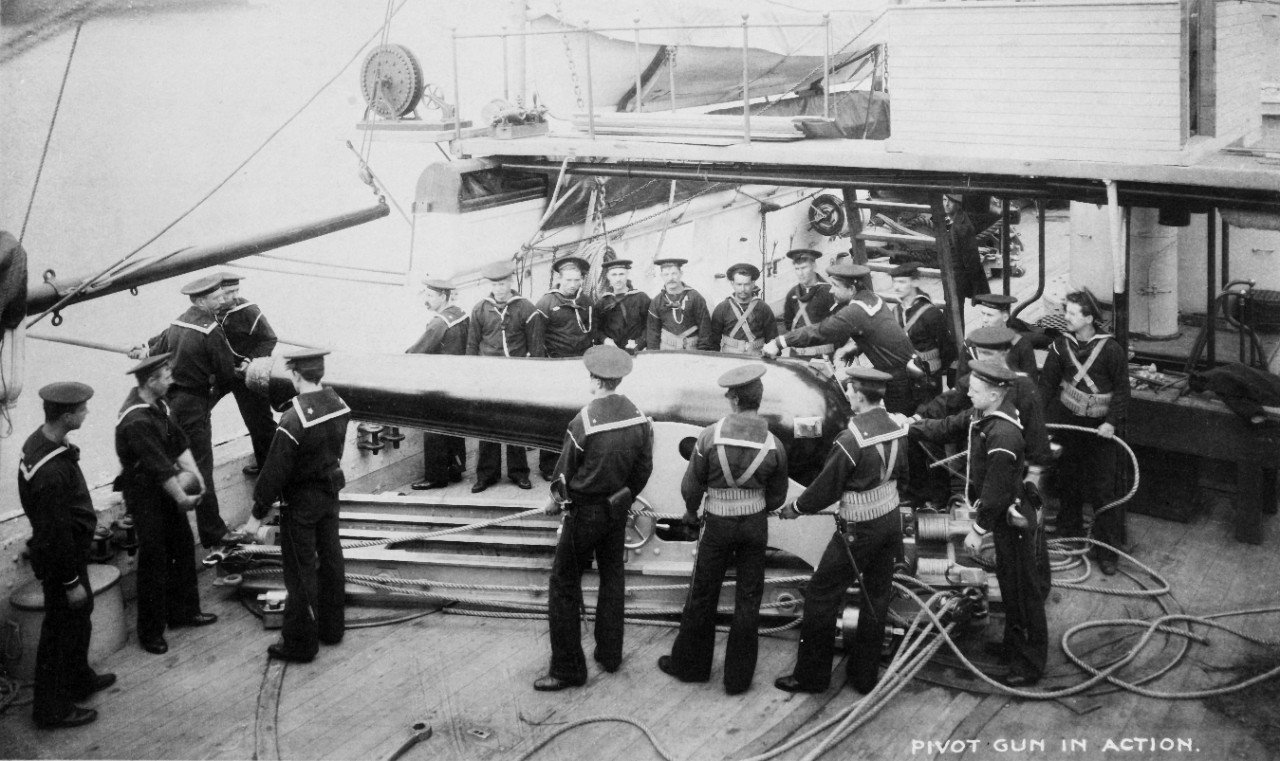
Photo Above: 8-Inch MLR of USS Enterprise with Crew at Drill. The photographer took this photo standing on the forecastle looking aft. The 8-Inch MLR is run out to port. Note, the sailor holding a projectile appears to be holding a 9-Inch Round shot or shell rather than the 8-Inch Projectile. Naval History and Heritage Command Photo NH 54202.
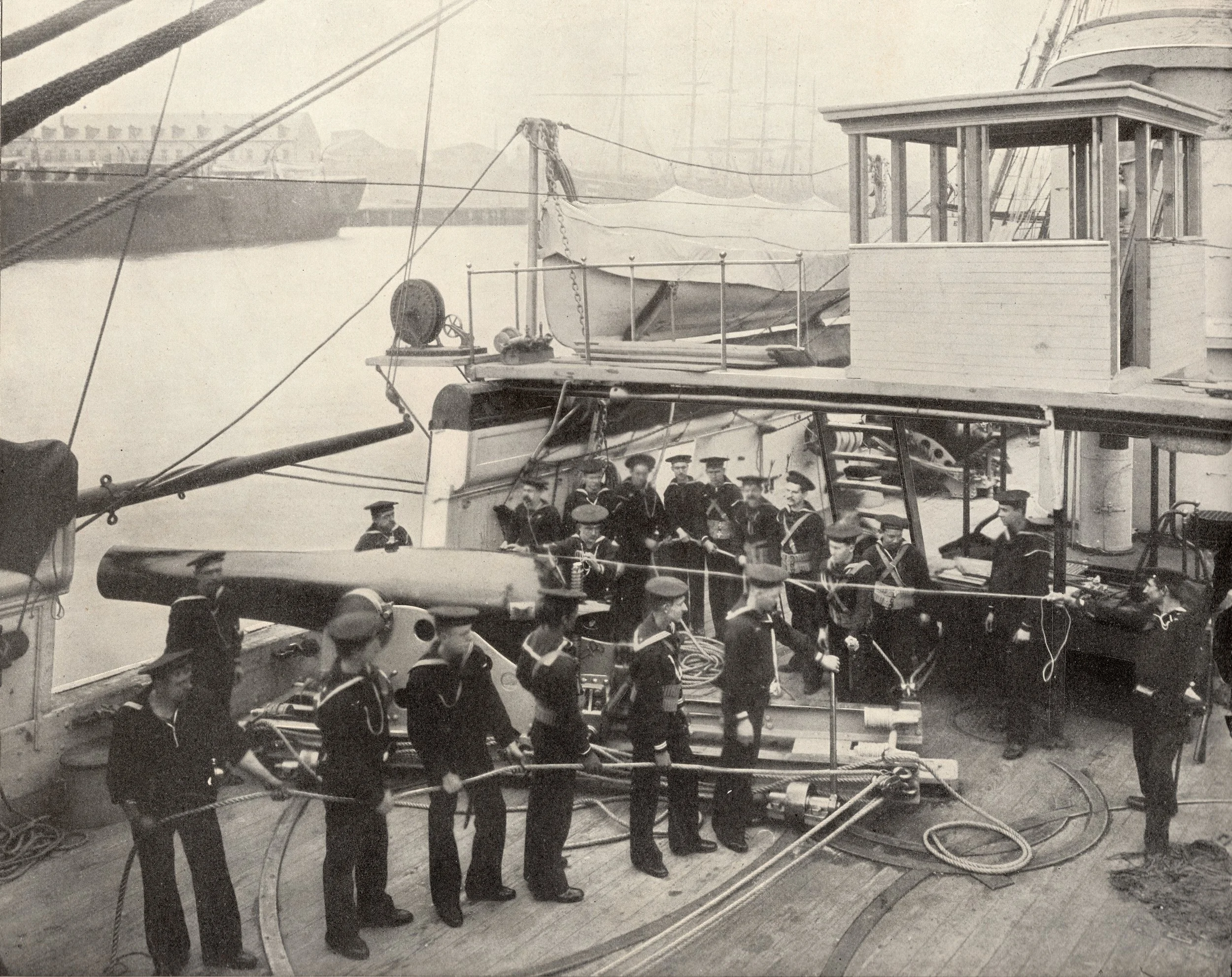
Photo Above: This photo published in an 1898 periodical appears to show the same gun crew as the NHHC photo. The gun has been run out and is ready to “fire”. Note the 9-Inch Dahlgren aft on the gun deck. (Author’s Collection)
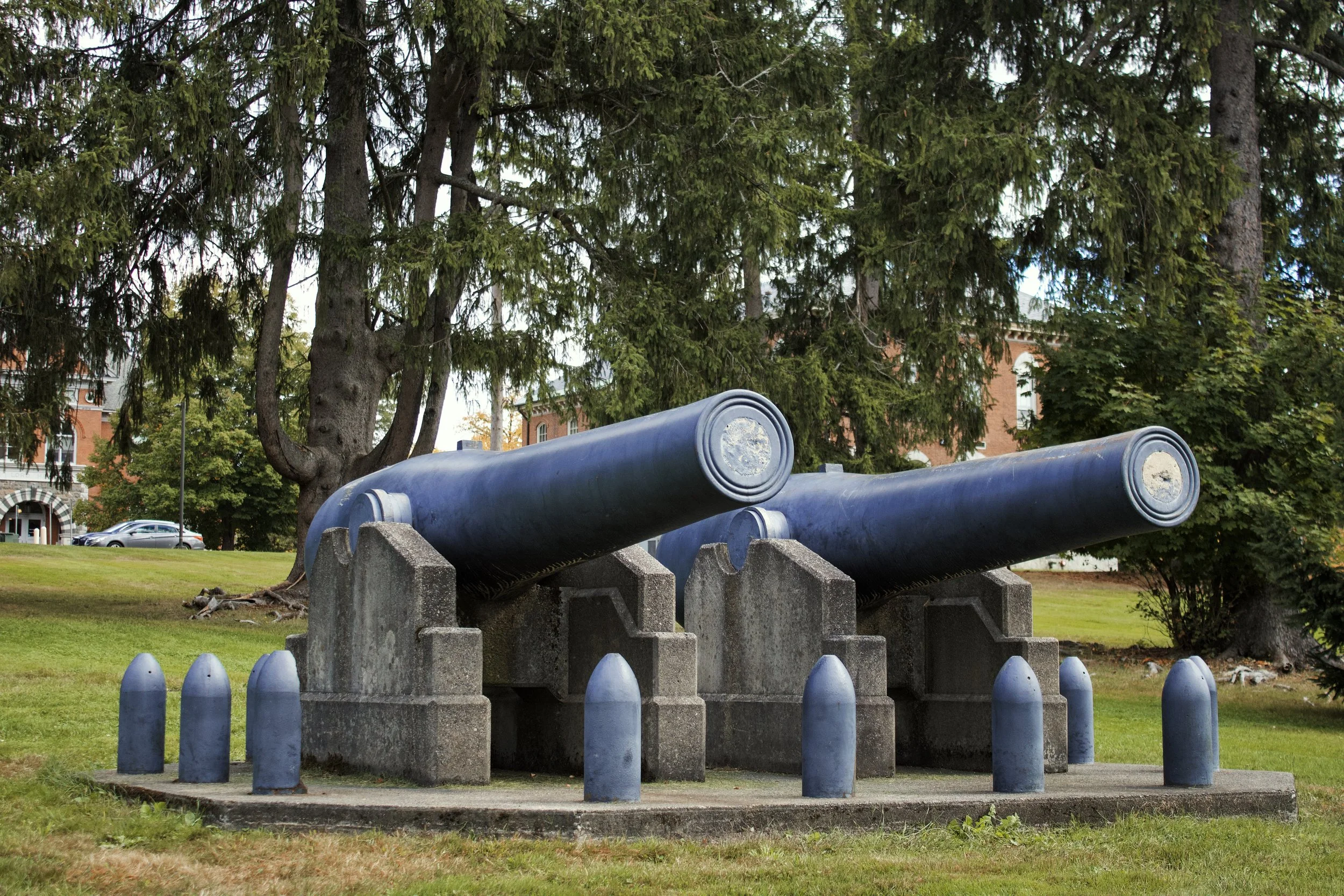
Photo Above: Two US Navy 8-Inch Muzzle Loading Rifles, Numbers 12 and 16, at the University of Maine. The display may show original 8-Inch Projectiles used with the 8-Inch MLR.
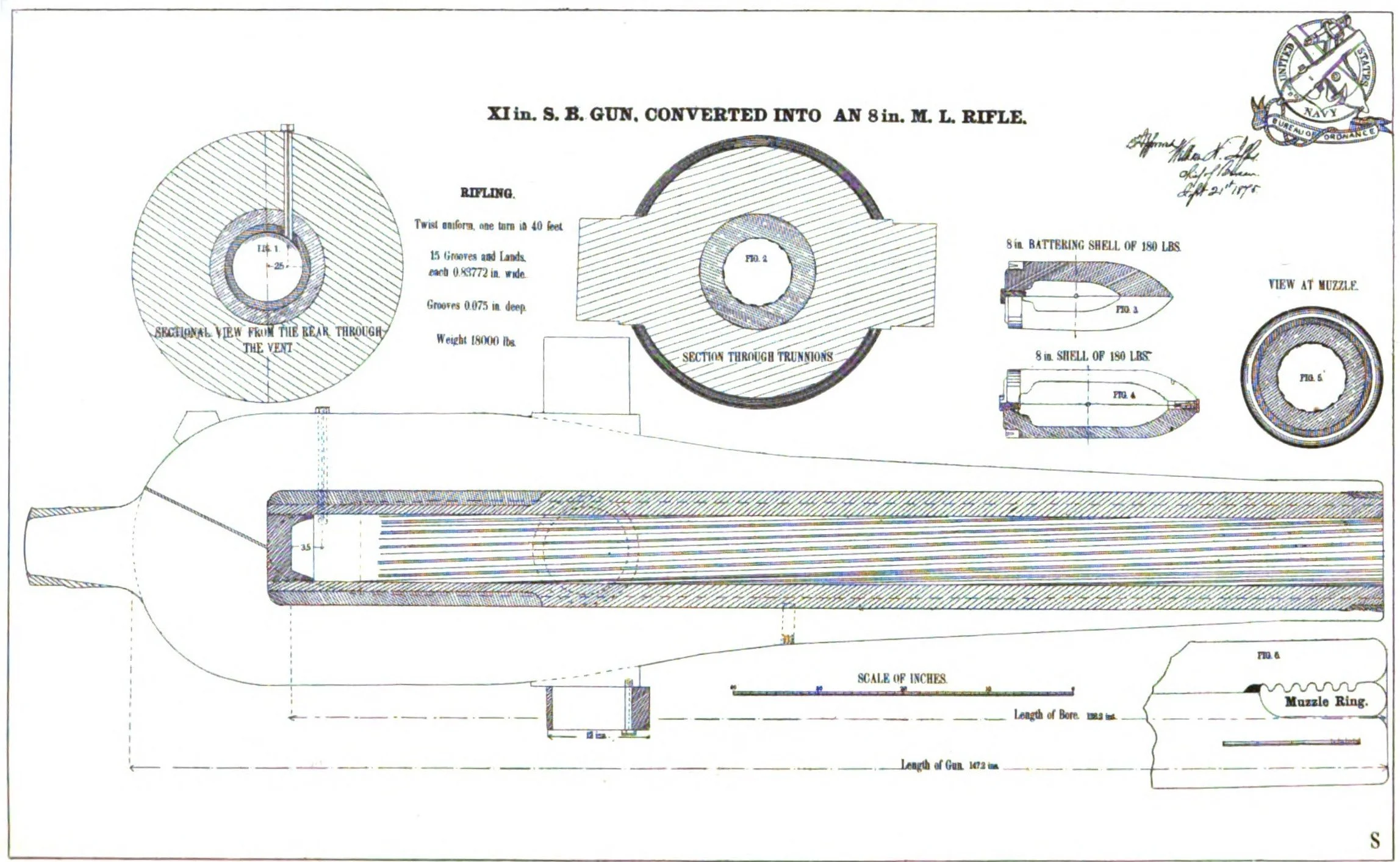
Photo Above: Cross section of US Navy 8-Inch MRL and projectiles. US Navy Ordnance Instructions, 1880, Pg. 189.
The US Navy 60-Pounder Breech Loading Rifle
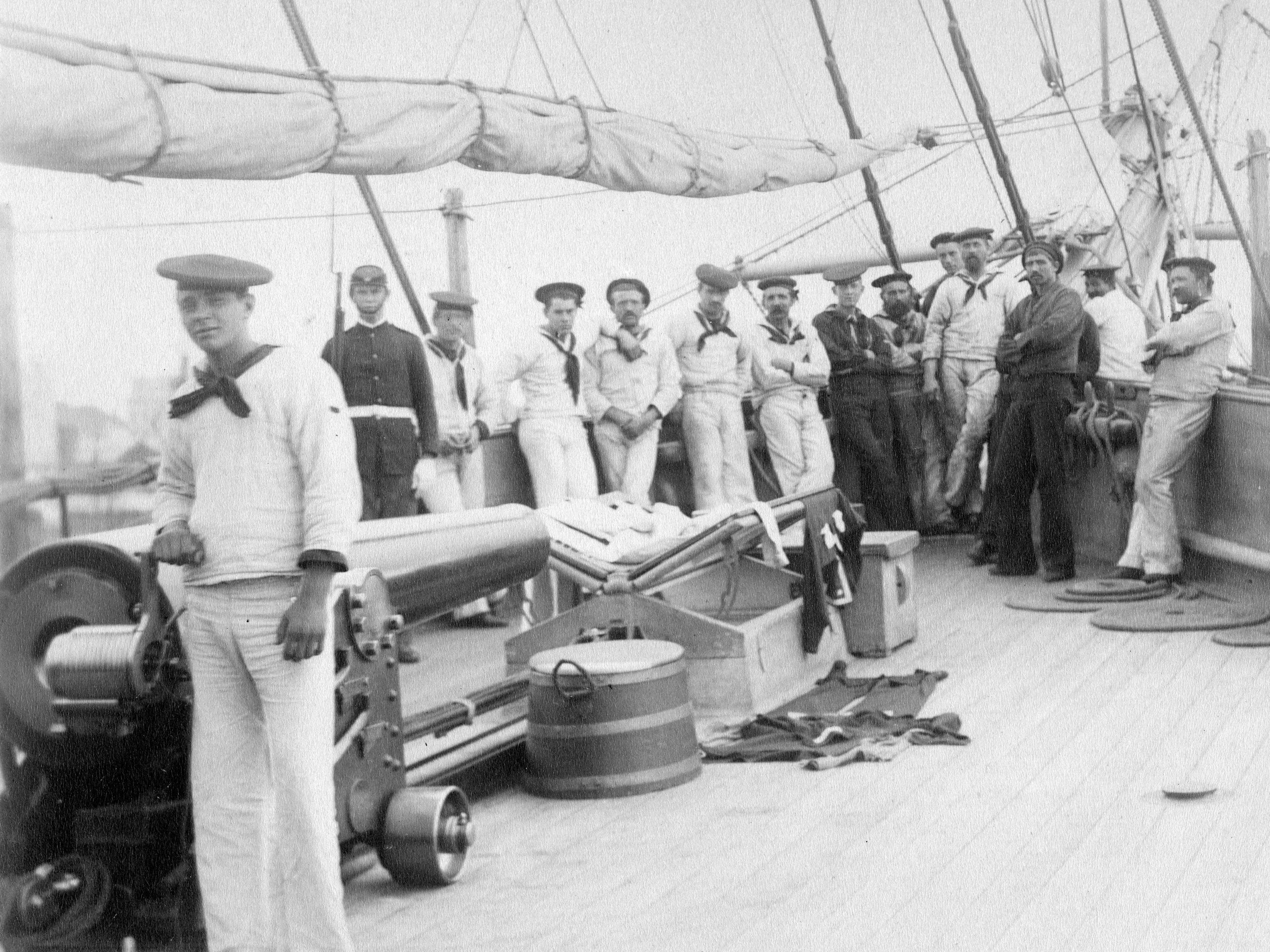
Photo Above: A group of US Navy Sailors and a Marine pose on the forecastle of USS Quinnebaug in the 1880s. Of interest is the 60-Pounder BLR with the open breech block. It is mounted on a directing bar carriage that could be pivoted to fire to either side of the ship. The 60-Pounder and its carriage are identical (or nearly so) to those carried aboard Enterprise after 1882. Naval History and Heritage Command Photo: NHF-012.01
USS Enterprise was initially equipped with 60-Pounder Parrott Rifle (a muzzle loader) Registry Number 98.
The in its original muzzle-loading form had been first ordered in 1864 to fill a gap in the US Navy's Parrott lineup between the 30-Pounder (about 3,500 pounds) and the 100-Pounder (about 9,700 pounds). A few examples saw action before the end of the American Civil War, including at least one at Fort Fisher. Postwar it became the standard forecastle armament of almost all active US Navy sloops and gunboats.
From 1879 to 1885, twenty-nine were converted to breechloaders, in which form they would continue to see service afloat well into the 1890s. The original cast iron breech was sliced off, the barrel bored out from the breech, and a steel sleeve which ran roughly to the trunnions inserted. This sleeve accommodated an interrupted screw breech block.
The 60-Pounder Breech Loading Rifle fired a 40 to 50 Pound projectile with a 6 pound charge in a cloth cartridge bag (See 1880 Ordnance Instructions).
Seven 60-Pounders are known to survive - four of which are breechloaders.
Illustration Above: a US Navy Directing Bar Carriage and 60-Pounder Parrott Rifle appearing in page 376 of the 1880 edition of Augustus Paul Cooke's A Text-book of Naval Ordnance and Gunnery, Volume 2.
Photo Above: US Navy 60-Pounder BLR Number 42 on the upper portion of a directing bar carriage in Laconia, New Hampshire. See the post on the Laconia 60-Pounders.

Cutaway illustration of an 6.4-Inch ("80-Pounder") Parrott Breech Loading Rifle and illustration of the breech of an 80-Pounder BLR. The 80-Pounder was a nearly identical (to the 60-Pounder) conversion of the larger 6.4-Inch 100-Pounder Parrott Rifle. Illustrations from Augustus Paul Cooke's A Text-book of Naval Ordnance and Gunnery, Volume 1 - Digitized by Google here: https://books.google.com/books?id=vTZ92PqoNlgC
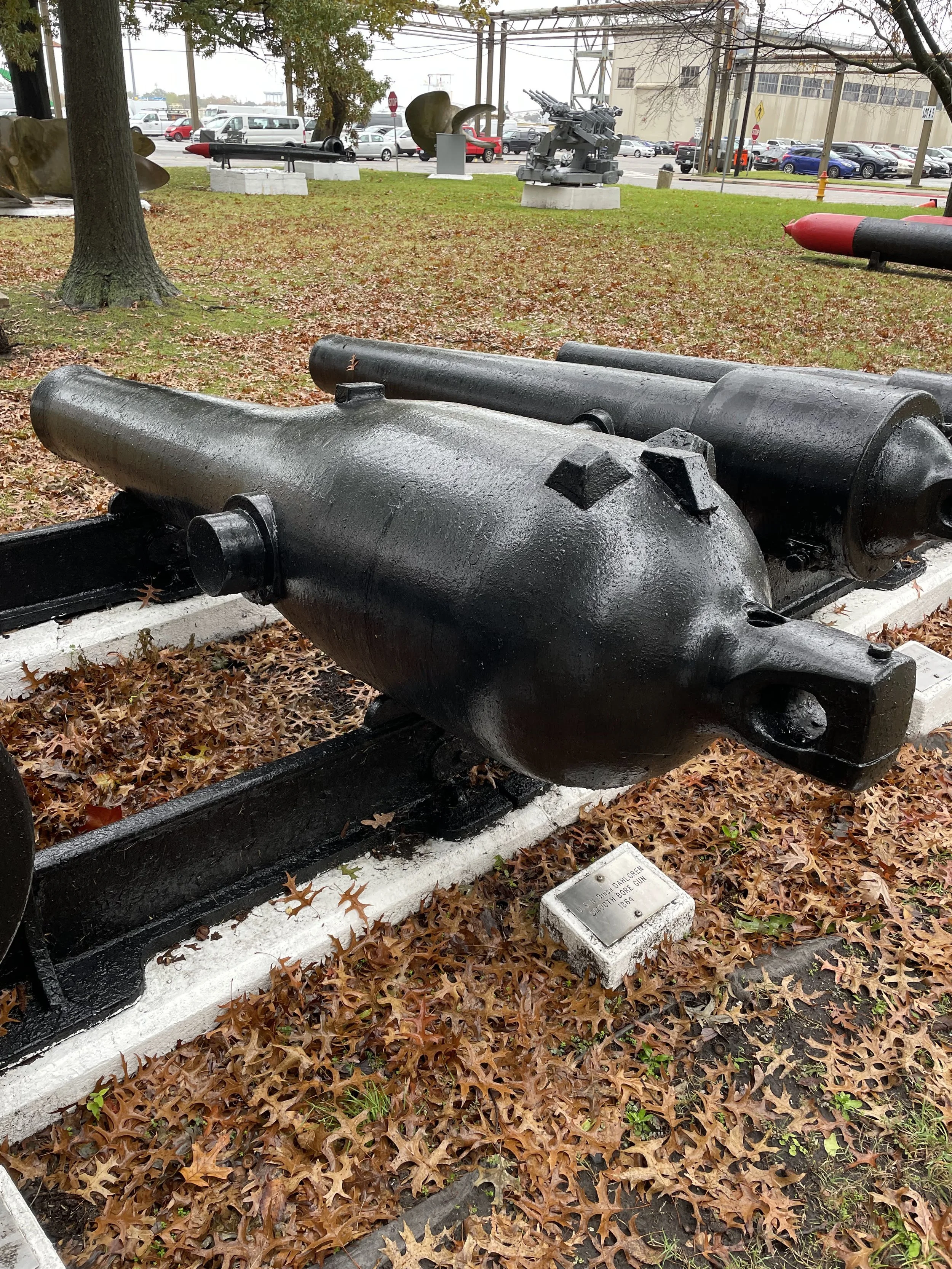
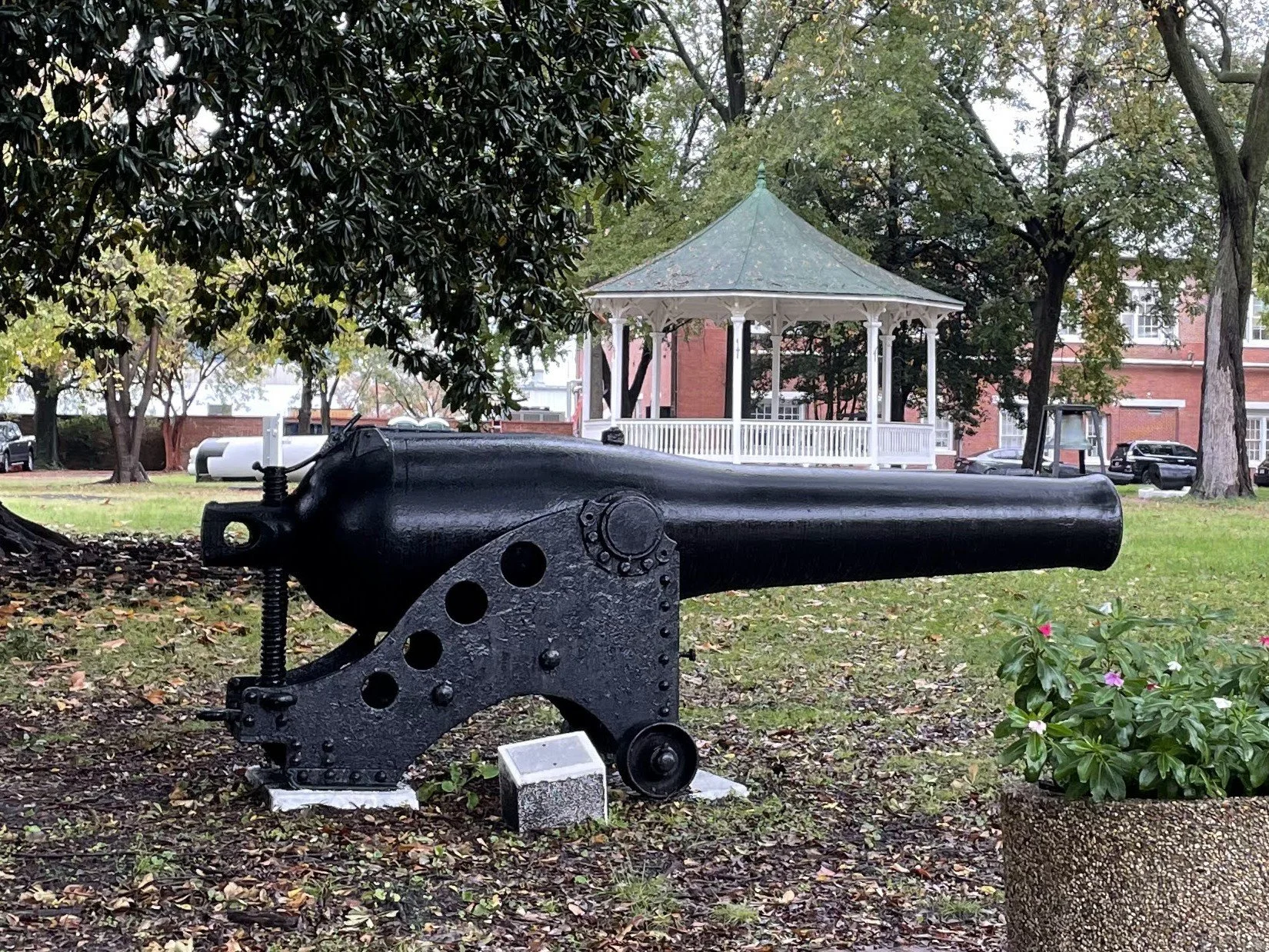
US Navy 9-Inch Dahlgrens
Photo at left: US Navy 9-Inch Dahlgren Number Number 887 at Trophy Park at Norfolk Naval Shipyard. Number 887 was carried aboard USS Enterprise beginning in the late 1880s.
USS Enterprise carried four 9-Inch Dahlgren guns - two on each broadside. They were mounted on iron Marsilly carriages which were an evolution of tradition naval broadside carriages which had been in use for centuries. The Marsilly carriage replaced the rear wheels with iron skids to help absorb recoil.
The Dahlgren gun was designed by US Navy Officer John A. Dahlgren in the 1850s. Dahlgren gave his shell guns a “soda-bottle” shape the featured a thick breech which rapidly narrowed. See the post on Dahlgren Guns.
The 9-Inch fired a 73-pound explosive shell or 90-pound shot with a 10-pound propellant charge. (A 13-Pound charge was authorized for use against armored vessels.) Both projectiles were round.
While the 9-Inch Dahlgren provided good service during the American Civil War, being carried in large numbers in the fleet, by the 1880s it was obsolete. In 1882, the Secretary of the Navy stated that “the smoothbore guns are incapable of contending with rifled guns through one half their weight of shot.”
Despite being obsolete, in 1883 the 9-Inch Dahlgren was by far the most numerous type in service afloat with the United States Navy with almost every cruising sloop and gunboat carrying a battery of the old guns.
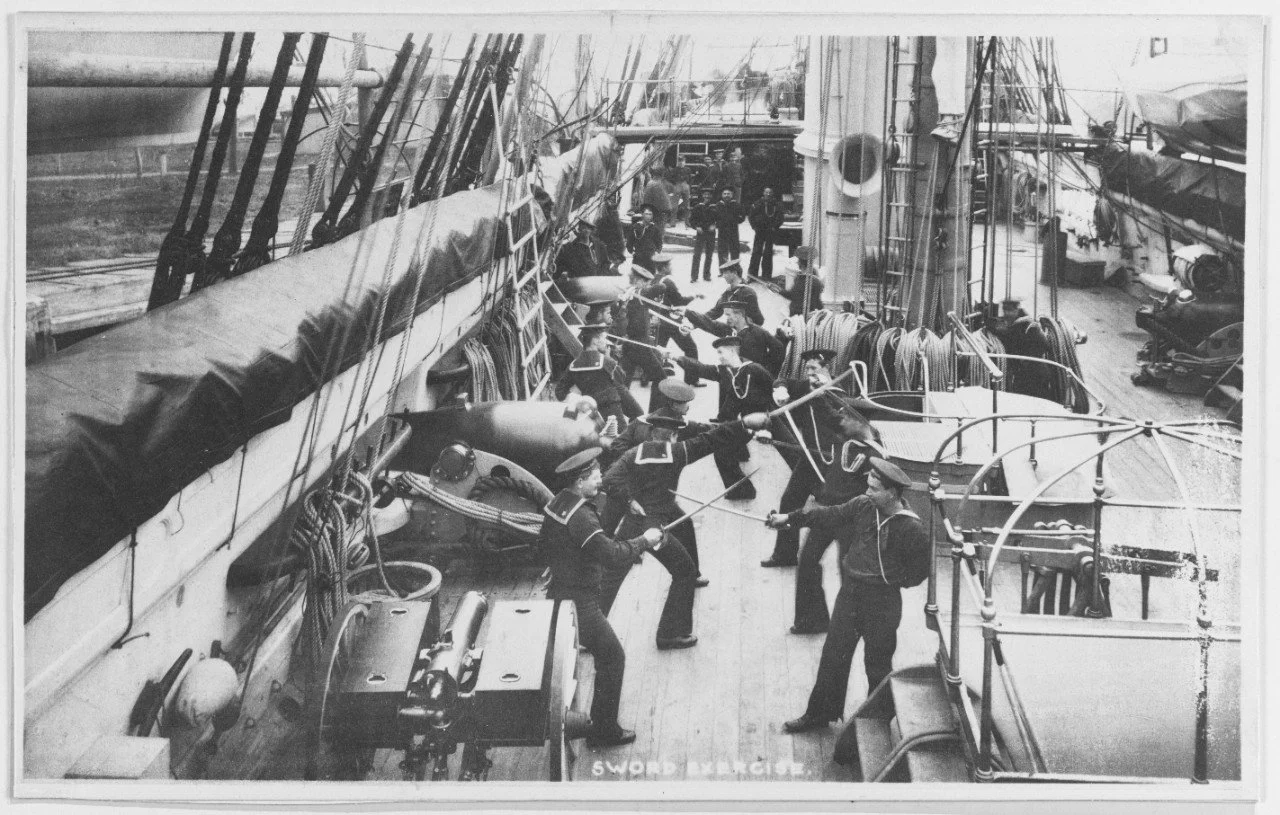
Photo Above: Sailors aboard Enterprise circa 1890 drill with cutlasses. They are standing beside the ship’s 9-Inch Dahlgrens on the main deck. Naval History and Heritage Command Photo NH 54205.
US Navy sailors “Spinning a Yarn” (telling stories) on the main deck beside the 9-Inch Dahlgren guns. Naval History and Heritage Command Photo NH 47029
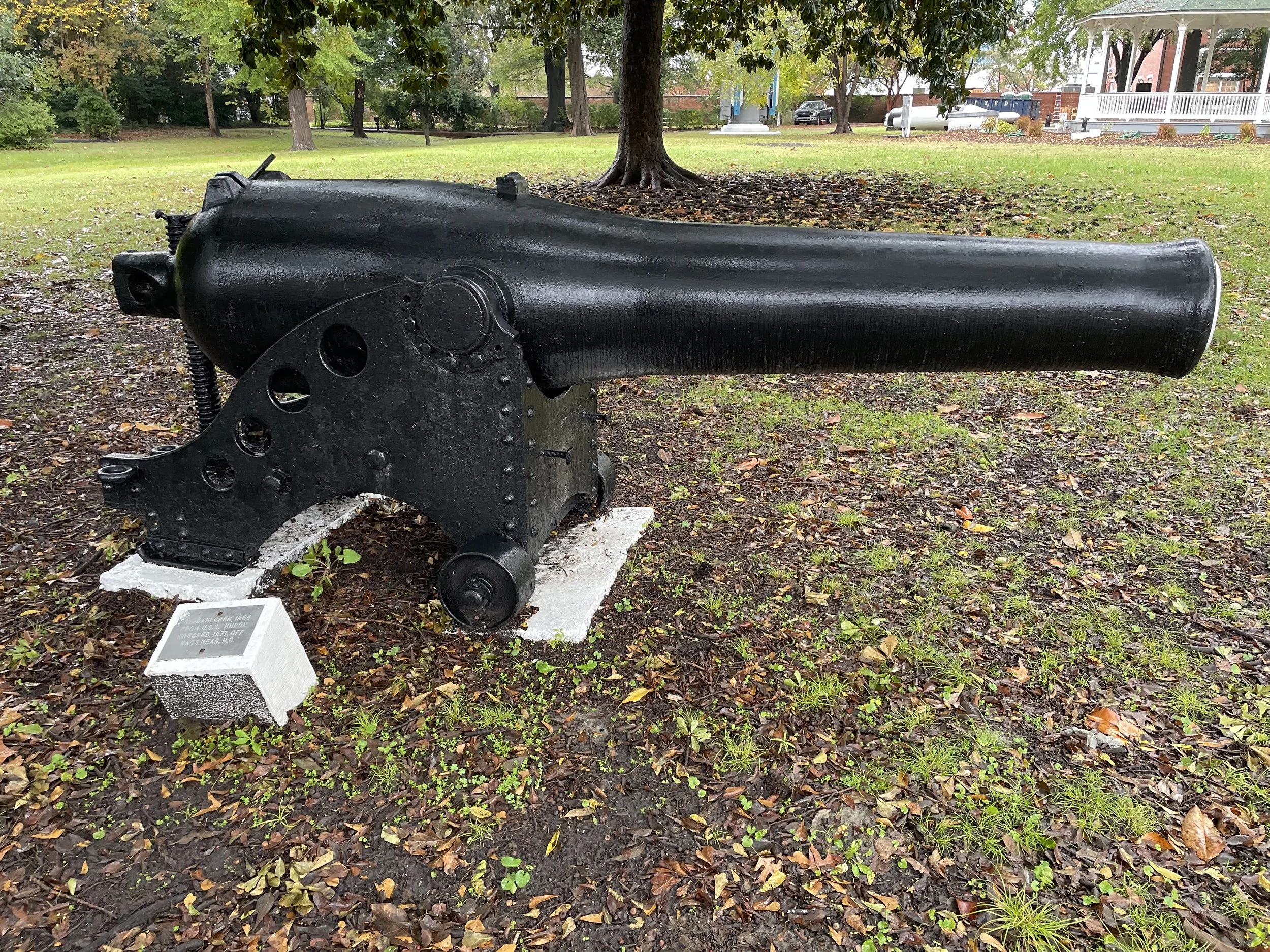
Photos above: US Navy 9-Inch Dahlgren Number 1178 of USS Huron at Norfolk Naval Shipyard. Number 1178 is mounted on an original iron Marsilly carriage like those carried aboard USS Enterprise.
Photo Above: USS Enterprise - Naval History and Heritage Command Photo NH 54398