The “Widow Blakely” at Vicksburg
The “Widow Blakely” is displayed at Vicksburg National Military Park
The “Widow Blakely” is displayed at Vicksburg National Military Park. Originally the piece was a British 42-Pounder smoothbore gun manufactured in 1862 by the Low Moor Iron Company in Bradford, Yorkshire. It was reamed out to 7.5 inches, rifled, and banded by Blakely.
Many thanks to friend-of-the-page Jeff Brantly for sharing these photos!
According to the National Park Service, it is one of the few guns displayed at Vicksburg known with certainty to have been present at the siege. It appears to have been called the “Widow Blakely” because it was the only Blakely rifle present in Vicksburg’s defenses.
The Widow Blakely was damaged by a shell which exploded at the muzzle on May 22nd, 1863. The damaged portion of the gun was removed and the shortened piece returned to service. I photographed an undamaged example of this type of Blakely at the Washington Navy Yard.
The Widow Blakely was previously displayed at a site on Louisiana Circle overlooking the Mississippi River. I believe an National Park Service social media post indicates that it has since been removed for display for conservation and is being held for display in a to-be-built interpretive center for the park.
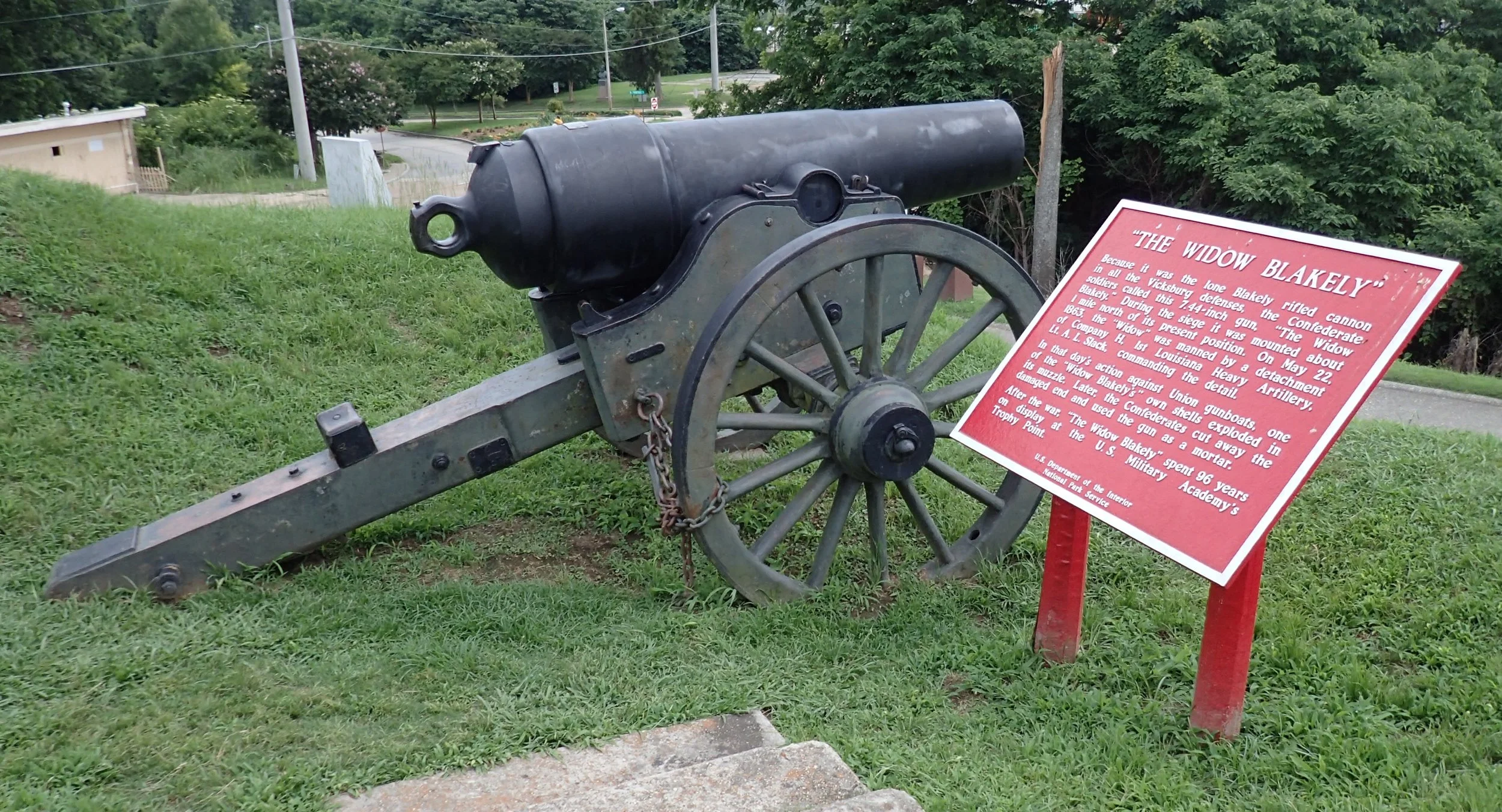
The “Widow Blakely” is displayed at Vicksburg National Military Park
A Report of Col. Edward Higgins, C. S. Artillery, commanding River Batteries at Vicksburg mentions the Blakely:
“The line of batteries extended along the river front, commencing at a point above Fort Hill, on the right of my line, to a redoubt which terminated the extreme right of the rear lines and met my left, a distance of 3 miles., and consisted of 8 10-Inch Columbiads, 1 9-Inch Dahlgren, 1 8-inch columbiad, 1 7.44-inch Blakely gun, 1 7-inch Brooks, 1 6.4-inch Brooks, 3 smooth-bore 42-pounders, 2 smooth-bore 32-pounders, 8 banded and unbanded 32-pounder rifles, 1 18-pounder rifle, 1 20-pounder Parrott, 1 Whitworth, 1 10-inch mortar, 1 8-inch siege howitzer, making in all 31 pieces of heavy artillery, besides 13 pieces of light artillery, which were placed in position to prevent a landing of the enemy on the city front. These batteries were divided into three commands, as follows: The upper batteries, from Fort Hill to the upper bayou, were worked by the First Tennessee Artillery, under Col. Andrew Jackson, jr. The center batteries, or those immediately on the city front, were under charge of Maj. F. 37. Ogden, Eighth Louisiana Artillery Battalion, to whose command was attached Capt. S. C. Bains’ company, of Vaiden Light Artillery. The lower batteries were in charge of the First Louisiana Artillery, under Lieut. Col. D. Beltzhoover. A portion of the Twenty-third [Twenty-second] Louisiana Volunteers was joined to Lieutenant-Colonel Beltzhoover’s command.”
The report goes on to mention that “On the 22nd (of May), at 9 a. m., four iron-clads and one wooden gunboat engaged the lower batteries, and after an engagement of one hour and a half were repulsed. Two of the iron-clads were seriously damaged. This engagement was creditable to the First Louisiana Artillery, who, with ten guns, mostly of small caliber, contested successfully against thirty-two heavy guns of the enemy. Our casualties were only 2 wounded during the fight; one 10-inch columbiad and the 18-pounder rifled gun were temporarily disabled. The Blakely gun burst at the muzzle.” (Official Records. ser.1:v.24: Pt 2. Pp. 336-338).
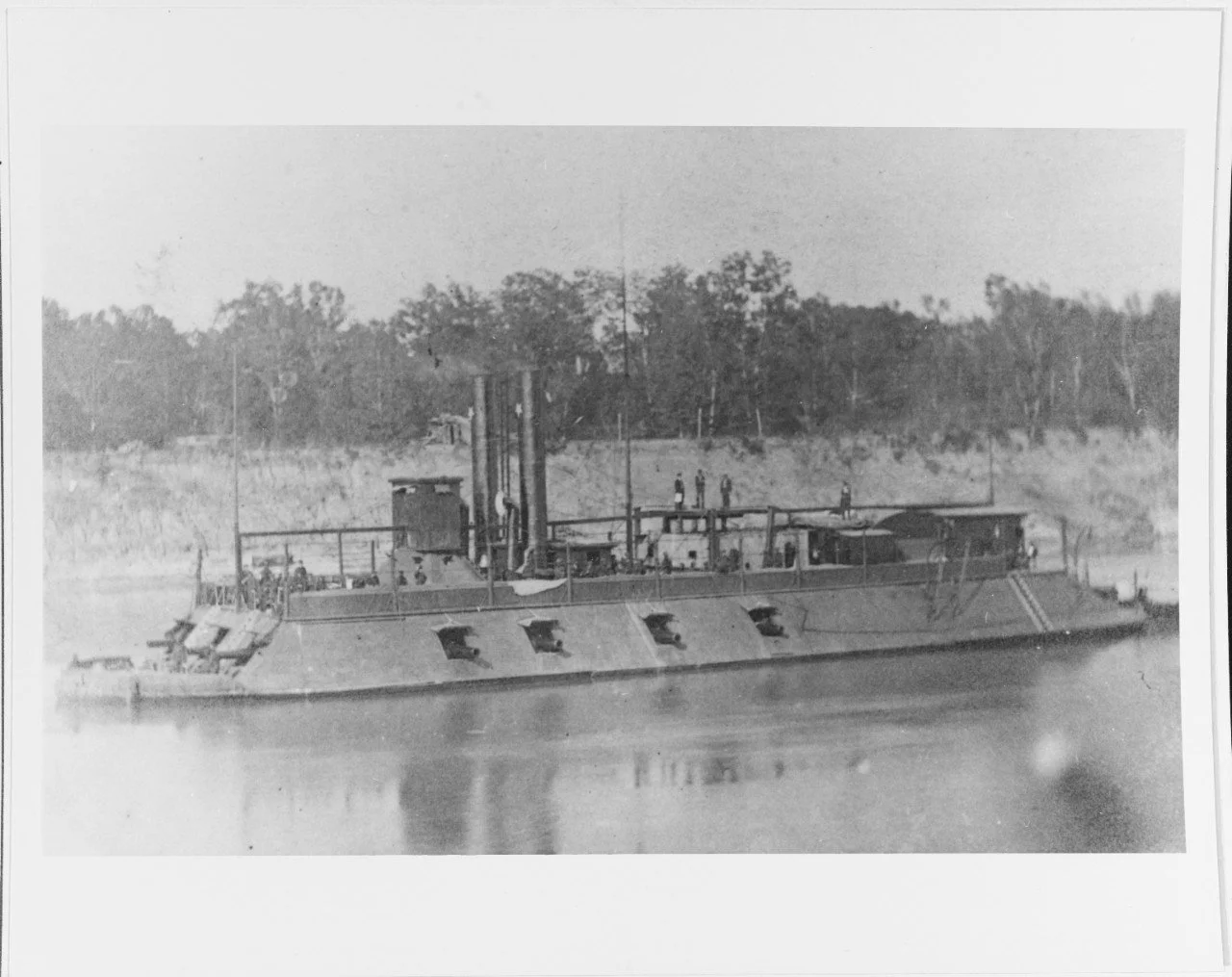
USS Mound City, sister ship of USS Cairo, is shown later in the war in 1864-1865. Naval History and Heritage Command Photo NH 72806
Rear Admiral David D. Porter’s account of the action states in part:
“The three gunboats passed up slowly, owing to the strong current, the Mound City leading, Benton following, and Carondelet astern. The water batteries opened furiously, supported by a hill battery on the starboard beam of the vessels. The vessels advanced to within 440 yards (by our marks) and returned the fire for two hours without cessation, the enemy's fire being very accurate and incessant.
Finding that the hill batteries behind us were silenced, I ordered up the Tuscumbia to within 800 yards of the batteries, but her turret was soon made untenable, not standing the enemy's shot, and I made her drop down.
I had been engaged with the forts an hour longer than General Grant asked; the vessels had all received severe shots under water which we could not stop up while in motion, and not knowing what might have delayed the movement of the army, I ordered the vessels to drop out of fire, which they did in a cool, handsome, manner.
This was the hottest fire the gunboats have ever been under, but owing to the water batteries being more on a level with them than usual, the gunboats. threw in their shell so fast that the aim of the enemy was not very good.
The enemy hit the vessels a number of times, but, fighting bow on, the shot did but little damage; not a man was killed, and only a few wounded. I had only ammunition enough for a few moments longer, and set all hands to work to fill up from our depot below.” (Official Records - Navies. Series 1. Volume 25. Page 22.)
Interpretive plaque beside the Blakely.
View of the bore and rifling of the Blakely
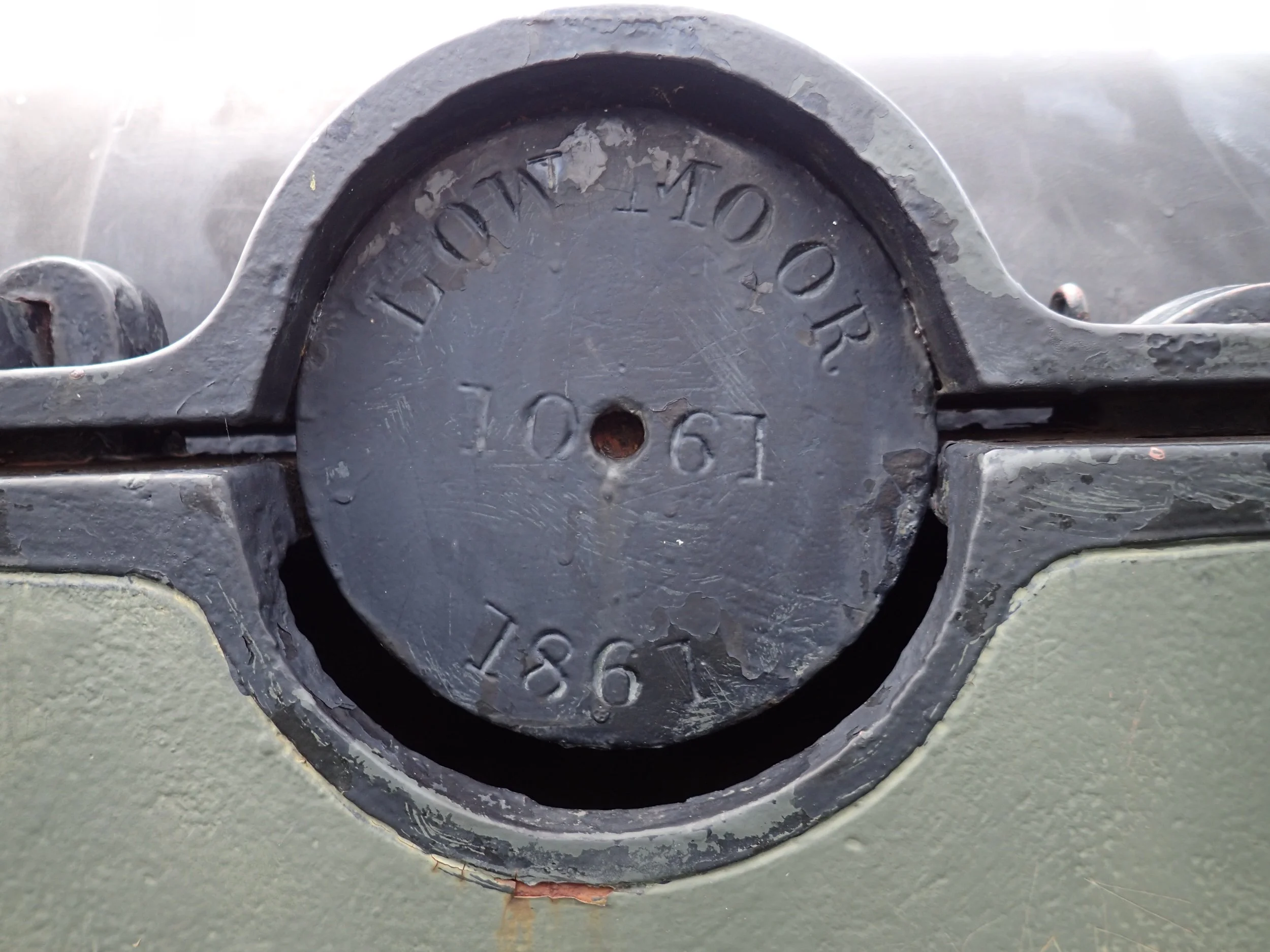
Trunnion of the Widow Blakely showing the original 1861 casting date at Low Moor and 10,000+ pound weight
The Widow Blakely at Vicksburg
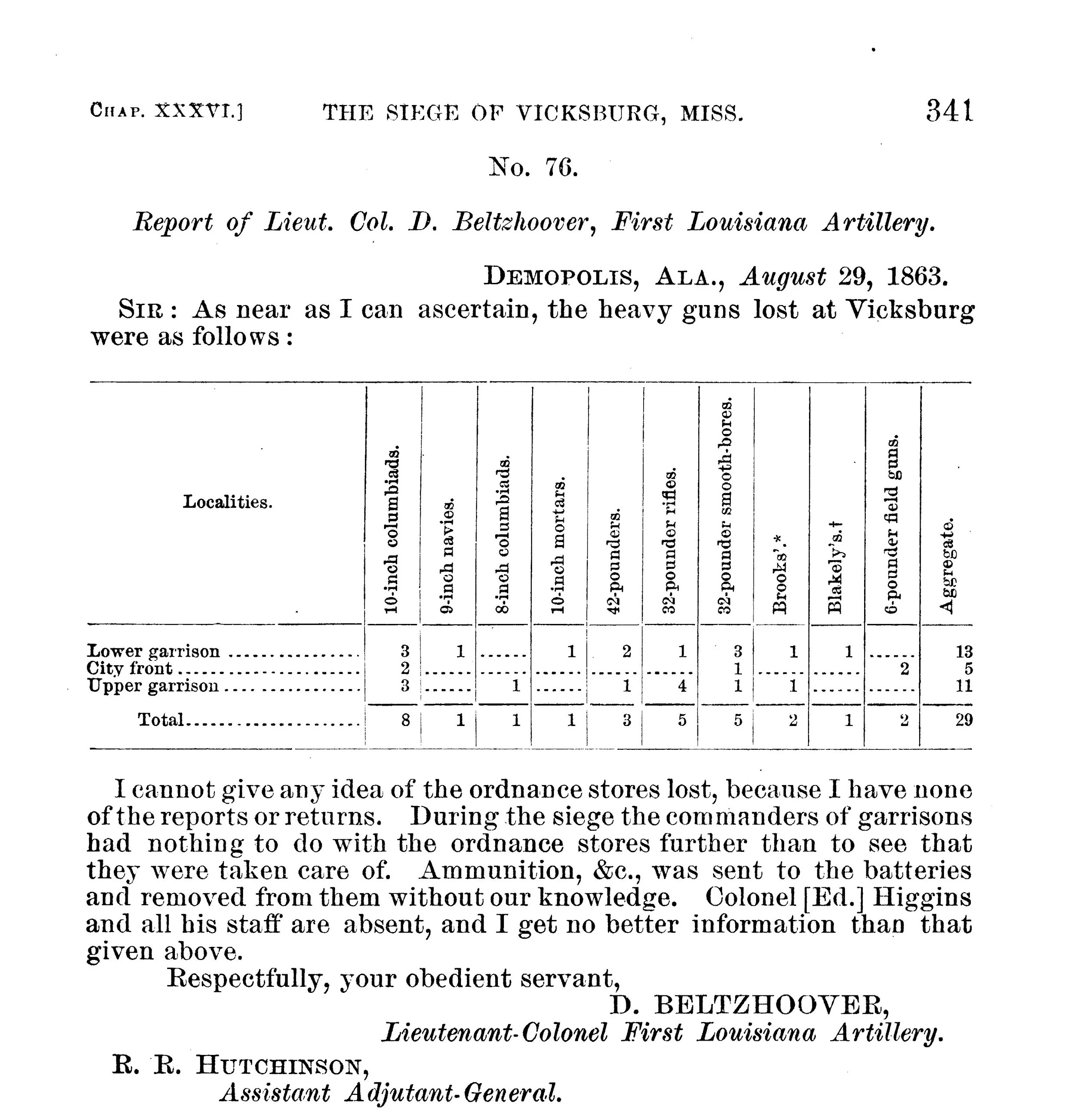
Confederate Heavy Artillery lost at Vicksburg. See the Official Records.
In 2024 I photographed a 7.5-Inch Blakely at the Washington Navy Yard which shows how the "Widow" would have looked before her muzzle burst during a May 22nd, 1863 action against Porter's ironclads. Like the "Widow", this piece started out as a British 42-Pounder smoothbore which was bored out to 7.5 inches, rifled, and banded. It is marked as weighing 10,759 pounds, and it may have come in the same shipment as the "Widow". The WNY example is engraved "Left by Rebels at Shipping Point, Potomac River."
National Park Service Social Media Post: “The Widow Blakely is a special cannon, being one of the few cannons in the parks collection that we know was used at Vicksburg during the siege. A few months ago, we sent the cannon out to a specialized metal conservator in preparation for display in the new partnership interpretive center” March 27, 2025 - Vicksburg National Military Park