Service Charges for Naval Guns During and After the American Civil War
Photo Above: US Navy 9-Inch Dahlgren Number 1178 at Norfolk Naval Shipyard. Read more about this Dahlgren here: https://www.santee1821.net/preserved-artillery/the-9-inch-dahlgren-of-uss-huron-at-trophy-park
John Dahlgren's November 1862 report as Chief of the Bureau of Ordnance of the US Navy includes a lengthy discussion on ordnance and ironclads. The entire report is worth a read, but below are three quotes from the report dealing with the experiments showing that the 11-Inch Dahlgren, which was designed to fire shell with a 15 pound charge, could successfully withstand firing shot with 30 pound charges.
Whereas his reports in the OR-N directly after the March battle show concern about overstressing Monitor's guns by using wrought-iron shot (which weighed several pounds more than cast iron) to the point that Dahlgren advocated the use of copper-coated hollow shot for a subsequent engagement, the November report shows that Dahlgren and BuOrd had been busy through the summer in pushing the 11-Inch to its limits - and found those limits to be quite a bit more than expected.
"The XI-inch guns of the "Monitor" were designed chiefly for shells, which were computed to leave with a velocity of at least 1,250 to 1,300 feet. In the action shot were used with an initial velocity of about 1,120 feet. But since that time the same class of gun has been ascertained to be capable of throwing solid shot of 169 pounds, with a charge of 30 pounds, giving an initial velocity of 1,400 feet."
"The cast-iron shot does break and the wrought-iron is only crushed; but while the latter lodges in the 4 1/2-inch plate, the former (both being of 11 inches) passes completely through the plate and nearly through the wooden backing of 20 inches, making a larger hole and badly cracking the plate. The proper mode of increasing the power of the Monitor's guns was to have increased the charge, which the gun was capable of enduring safely, to the extent of 30 pounds; but this was not known at the time, and all will admit that the occasion was not one when any risk was to be incurred unnecessarily."
"It was not to be expected that ordnance designed so particularly for a given effect upon wooden structures should be equally fitted to operate upon armored vessels. Their application to this service was, therefore, temporary; and yet, even under such disadvantages, the XI-inch shot, fired with 30 pounds, is known to act severely on targets plated with 4 1/2-inch iron, and to have an endurance with these excessive charges that could not have been expected."
"One of this class, now here, has been fired 155 times, as follows:
22 rounds with 20 pounds
101 rounds with 25 pounds
32 rounds with 30 pounds"
(Shot of 165 to 169 pounds)
Read John Dahlgren’s 1862 Report here: https://babel.hathitrust.org/cgi/pt?id=coo.31924112651967&seq=717
"Service Charges for Naval Guns” 1860 vs. 1866. Immediate pre and post-war tables for service charges make an interesting comparison. Pre-war, the maximum charge for the XI-Inch Dahlgren was 15 pounds. As Dahlgren's November 1862 report shared above stated, heavier charges, up to 30 pounds, were found possible in the aftermath of the Battle of Hampton Roads. Despite this, the 30-Pound charge is only mentioned as a footnote in the 1866 table.
Note the X-Inch Dahlgren showing a maximum charge of 12.5-pounds in 1860 and 15-pounds in 1866 and the IX-Inch showing 10-pounds and 13-pounds respectively. Much has been made of the Monitor's XI-Inch Dahlgrens firing with "reduced" charges during the Battle of Hampton Roads. That was simply not the case as 15-Pounds was the proscribed charge at the time of the battle, and all of the IX-Inch and X-Inch Dahlgrens aboard Cumberland and Minnesota (and Virginia) were firing with charges lighter than would be authorized in the aftermath of the battle.
The 1866 table also shows the addition of rifled ordnance to the fleet. Though that table is interesting for what is not present: Dahlgren's early war rifles have been removed as has been the 150-Pounder Parrott. The 150-Pounder was recommended to be removed from service in an 1865 BuOrd “Report on Rifled Guns” following the bursting of 100-Pounder Parrotts during the First Bombardment of Fort Fisher.
Compare also to the 1880 table below
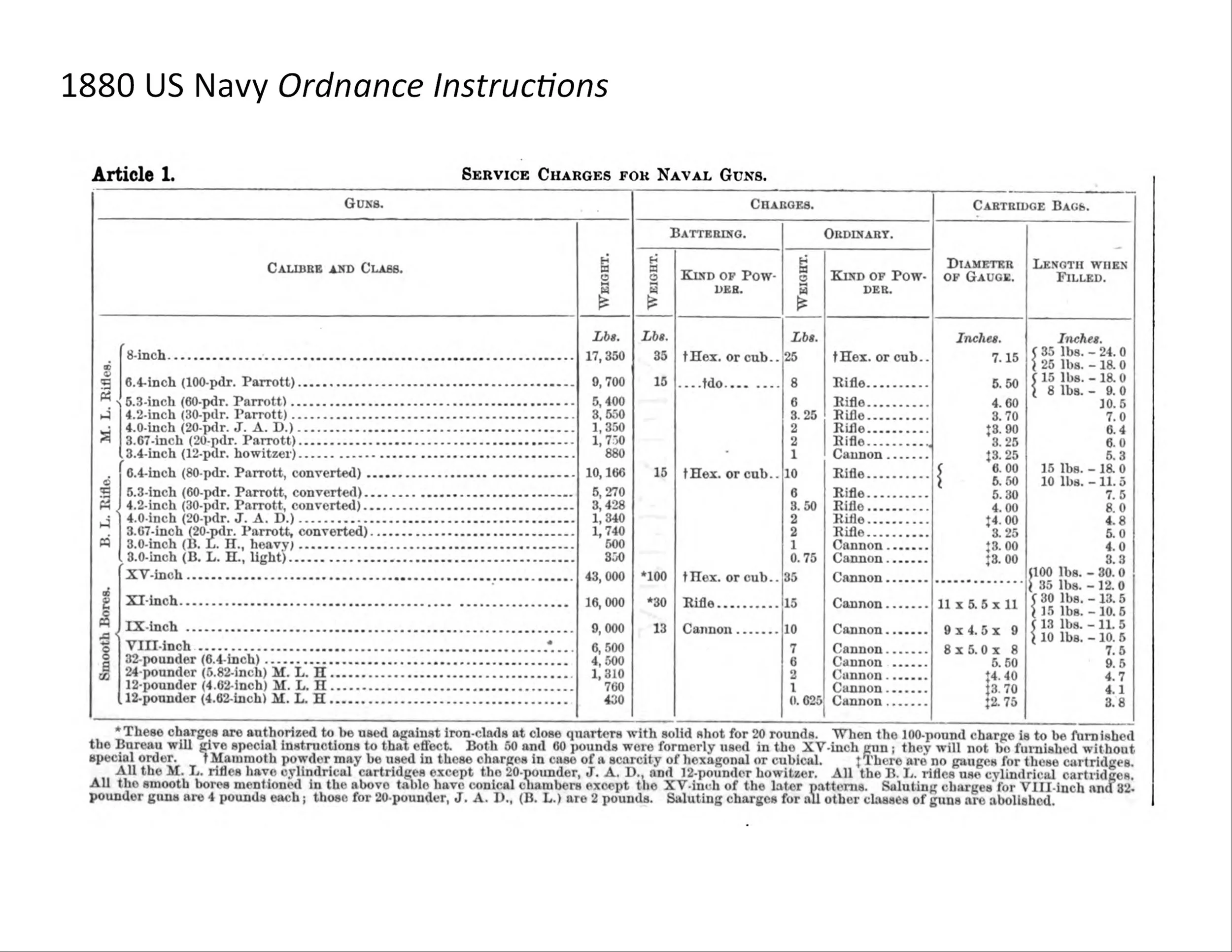
The 1860 Table can be found here: https://babel.hathitrust.org/cgi/pt?id=hvd.32044048698823&seq=191
The 1866 Table may be found here: https://babel.hathitrust.org/cgi/pt?id=rul.39030039861515&seq=295
The 1880 Table may be found here: https://babel.hathitrust.org/cgi/pt?id=nnc1.cu50745638&seq=480