USS Pennsylvania - The Largest Sailing Warship of the United States Navy
USS Pennsylvania was the largest sailing warship built for the United States Navy. When construction began on her in the early 1820s, she would have been among the largest and most powerful ships anywhere in the world. Arguably a “four-decker”, she was built to overpower any individual ship that she might encounter.
But, she took fifteen years to construct - entering service as the age of sail was transitioning to the age of steam and shellfire. Her only ocean voyage took her from Philadelphia where she was built to Norfolk, Virginia. She may have never been fully armed, and she was burned at the beginning of the Civil War never having fired a shot in anger.
Was Pennsylvania just a waste of resources. Was she an unlucky ship that never had her chance?
USS Constitution in 2026 - US Navy Photo
While it is well known that the US Navy built heavy frigates - USS Constitution, which was thrice victorious during the War of 1812, remains at Boston, and others may be familiar the other first six frigates such as USS United States, it is often less well known that the US Navy built a small fleet of ships of the line, the battleships of their era, beginning during the War of 1812.
Three ships of the line, Independence, Washington, and Franklin were built during the War of 1812, though they were not ready for active service until after the end of the war.. In April of 1816, the United States Congress passed a law for the “Gradual Increase of the Navy” which called for building nine ships, to rate not less than 74 guns each, and twelve ships to rate not less than 44 guns each (SecNav 1826, pg. 726).
Eight of the ships were officially referred to as 74 gun ships, which had been a popular rating of ship in the major European navies in the recent wars. A typical British 74 at the time of the battle of Trafalgar had twenty-eight 32-Pounders on her lower gun deck, twenty-eight 18-pounders on her upper gun deck, and a mix of carronades and light guns on her forecastle and quarterdecks - but the waist between the quarterdeck and forecastle was unarmed. By this period, the total number of guns and carronades was usually a bit above the total rate.
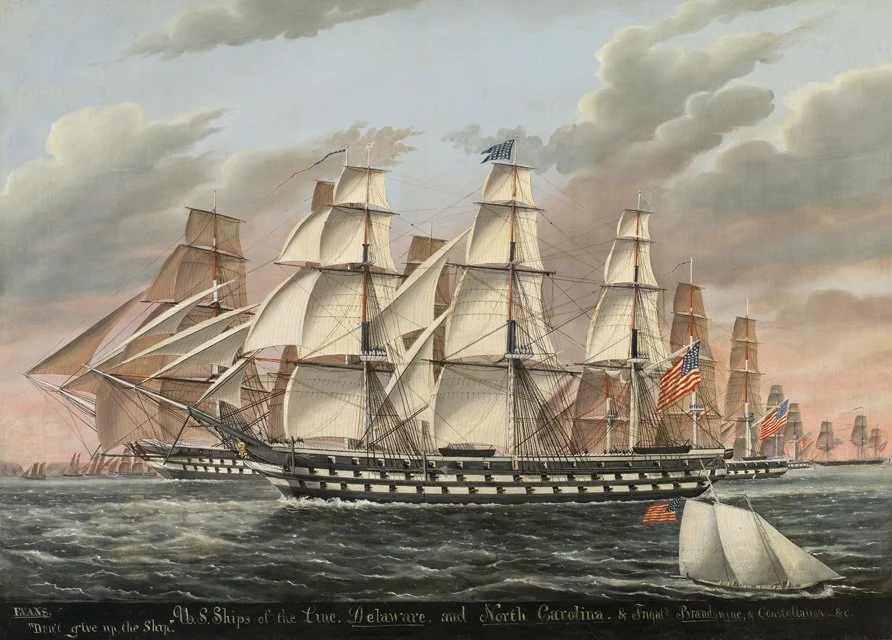
Painting showing the US Navy ships of the Line USS Delaware and USS North Carolina along with frigates and smaller ships
Though called 74’s, the US ships carried significantly more guns - and the beginning with Delaware and North Carolina, they carried significantly heavier ones, too. In her first commission, USS North Carolina carried 94 guns - possibly arranged as a lower deck battery of thirty-two 42-Pounders, an upper deck battery of thirty-two 32-Pounders, and thirty 42-Pounder carronades on the spar deck - firing a heavier broadside than many European 1st rates. (Laverly, Brian. The Ship of the Line. Vol. 1. Pg. 213).
The US Navy’s leadership wanted an even larger and more powerful ship to be built. The largest ships in the European Navies carried more than 100 guns and had three complete gun decks - again with additional guns on the forecastle and quarterdeck. Perhaps the most famous example of the type and Nelson’s flagship at Trafalgar, HMS Victory survives at Portsmouth.
Model for a proposed 74-Gun Ship for the Continental Navy carved by Joshua Humphrey’s in 1777. Displayed at the Independence Seaport Museum in Philadelphia
Pennsylvania was to be built at Philadelphia under the supervision of Samuel Humphreys. Samuel’s father Joshua Humphreys is a legendary figure in American shipbuilding. He designed USS Constitution and her sisters - including USS United States which he built at Philadelphia. The Independence seaport museum displays this wonderful diorama of USS United States under construction. Before that he contributed to the design of ships during the Revolutionary War for the Continental Navy - including the frigate Randolph. Randolph tragically exploded in action with the much larger HMS Yarmouth in 1778 (Canney, Donald. Sailing Warships of the US Navy, pg. 13). The Independence Seaport Museum also displays a model of a design for a ship of the line that Joshua Humphreys proposed as far back as the Revolution.
Diorama of USS United States (background) building at Philadelphia circa 1798. Independence Seaport Museum, Philadelphia.
His son, Samuel Humphreys assisted with the construction of the frigate USS Philadelphia in 1799 (Canney, pg. 52). In 1815, he designed and built USS Franklin - one of the first three US Navy ships of the line. Franklin, along with her contemporaries Washington and Independence were beautiful, heavily armed ships - but all three suffered from very low freeboard which made their lower deck guns all but useless (Canney, pg. 95).
USS Franklin Entering New York Harbor, 1820 - Metropolitan Museum of Art
Samuel Humphreys was given instructions to build a substantially larger ship than the other “Seventy Fours” which were building - including the recently completed North Carolina at Philadelphia. But, Commodore John Rodgers, hero of the War of 1812 and President of the Navy’s Board of Commissioners, instructed Humphreys to “avoid divulging” that the next ship to be built at Philadelphia was to be considerably larger than the others (Canney, pg. 107).
Samuel Humphreys - Naval History and Heritage Command
Spanish Ship Santisima Trinidad
Howard Chapelle wrote that Humphreys acquired plans for both the enormous Spanish ship Santisima Trinidad as well as HMS Royal Sovereign - two of the largest ships to have fought at the Battle of Trafalgar, but decidedly old fashioned by the 1820s. Chapelle claimed that the influence of these 18th century designs explains the appearance of a beakhead bulkhead at the bow in the original design of USS Pennsylvania (Chapelle, Howard. The History of the American Sailing Navy. pg. 339). Canney writes that Humphreys used the foreign ships as “benchmarks rather than patterns” and also notes that he built a full hull model of the design and immersed it to determine the ship’s displacement (Canney, pg. 107).
Possible early version of Pennsylvania’s head showing a figurehead of Neptune - National Archives
The first mention of Pennsylvania in the reports of the Secretary of the Navy was at the end of 1822, it was said that there was “One seventy-four at Philadelphia, keel laid, frame nearly out, house now building over, and probably raised by this time.” (SecNav 1822). By “house building over, it is meant a ship house over the slipway which would protect the ship from the elements - especially by keeping rainwater out of the vessel. By 1823, the Secretary of the Navy stated that Pennsylvania “could be launched in 180 days.” Work was proceeding very slowly by this point as in 1824 the estimate was 150 days.
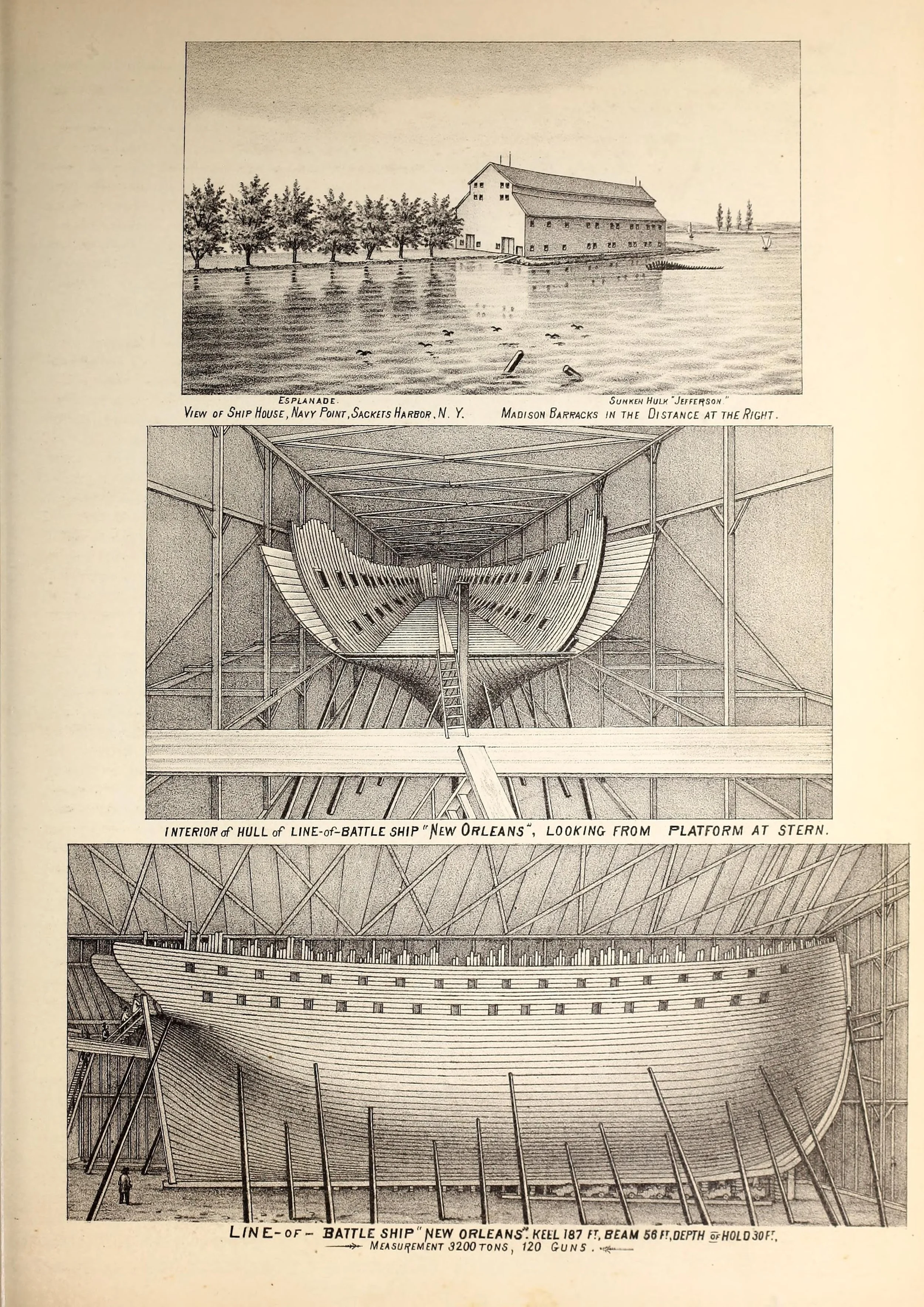
Illustrations of USS New Orleans building in a ship house at Sackets Harbor from History of Jefferson County, New York by Samuel W. Durant and Henry B. Peirce (1878), pg. 411.
The Dictionary of American Naval Fighting Ships claims - a claim that is often repeated, that the building of Pennsylvania as well as many of the other “Gradual Increase” ships took years and even decades because of the miserly appropriations of Congress. However, that is hard to square with the fact that all of the ships were near ready to launch by 1825 except for Pennsylvania. The 1825 report states, “The ships of the line and frigates now building, except the ship at Philadelphia, are nearly in as finished a state as is deemed advisable, until there is a probability of their being required for service; by leaving them uncaulked, and giving a free circulation of air, and being under cover, entirely protected from the weather, their timbers are improved by seasoning, and without doubt will be more durable than if launched immediately on being built—they can be launched in about ninety days. The ship at Philadelphia will require about five months.” (SecNav 1825, pg. 124).
Plan of USS Pennsylvania - National Archives
Pennsylvania may have been taking longer to finish simply because she was a bigger ship - and perhaps because the Navy didn’t want to show greater expenditures on her than on the others.
If there was penny pinching going on, it was that Congress did not want to fund a large fleet of operational ships of the line. During the 1820s it was not uncommon for one of the “liners” to be in service in the Mediterranean as a reminder that the young American Republic had a Navy that could be a handful, but Columbus, Delaware, and North Carolina were all that was needed to keep one ship constantly in service. The other ships of the line were held in reserve by being kept on the stocks in ship houses where their wood could continue to season.
In the reports to Congress, her name was first recorded as Pennsylvania in 1826. And it was in 1827 that the particularly diligent reader may have first noticed that Pennsylvania was of a different size than the others. While the other ships of the line building and built are described as 74s, Pennsylvania is just “a ship of the line.” But if you read the description of the decks - the report refers to a lower, middle, upper, and spar - the first mention that the ship has an additional deck.
The Philadelphia Navy Yard in 1864 - Library Company of Philadelphia
The apparent secrecy did not preclude a Royal Navy officer from visiting the shipyard at Philadelphia. He reported to the Admiralty that the navy yard at Philadelphia had two ship houses, one containing “Pennsylvania, the three decker” and the other “the Raritan, a first class frigate.” This officer, noted that the authorizing legislation had stated that the ships of the line each be “not less than 74 guns”, giving the commissioners of the Navy scope to build larger ships - and in Pennsylvania’s case, a considerably larger ship! The British officer visited Pennsylvania three times saying, “she is a beautiful model, remarkably well put together” with a live oak frame and white oak planking. She had a “fine entrance, clean run, full flaring bow, rounds in at the main deck ports, round stern with a counter,” and no poop deck (Lavery, Brian. The Ship of the Line. Vol 1. Pg. 212).
Plan of USS Pennsylvania - National Archives
According to the British officer, the ship was 223 feet long on the upper deck, 210 feet between perpendiculars. She was 56 feet 9 inches at the beam. She had 16 lower deck ports on each side, 19 middle deck ports, 20 main deck ports, and 19 spar deck ports - 74 ports on each side for 148 total gun ports. He reported that Pennsylvania’s intended armament was 32 42-Pounders on the lower deck, 34 32-Pounders on the middle deck, 36 24-pounders on the upper deck, and 34 42-Pounder carronades on the spar deck - 136 total guns, 68 on each side firing a total broadside 2,362 pounds - more than double the weight of HMS Victory’s broadside at Trafalgar (Lavery, Pp. 212-213).
Caledonia-class HMS Neptune, a contemporary of Pennsylvania, depicted in 1854 during the Crimean War
Of course, Victory was quite elderly by the 1820s, but Pennsylvania was larger and significantly more heavily armed than the Caledonia-class 120-gun ships which continued to be built for the Royal Navy in the 1820s and 1830s. Only the ships built at the very end of the Age of Sail in the late 1830s and 1840s competed with Pennsylvania in size (Canney, pp. 109-110).
By 1827, Pennsylvania was nearing completion. Indeed most of the ships whose construction had begun in the early 1820s were substantially complete. Pennsylvania’s frame was complete, she was “planked to her upper gun deck ports”, with her lower and middle gun decks planked as well and beams in place for the upper and spar decks. Her copper and ironwork was also nearly ready (SecNav 1827, pg. 254.)
Pennsylvania’s Stern - National Archives
Surviving plans from the National Archives show that her stern was to be elaborately decorated with classical figures. And alone among US Navy ships of the line she was to have two decks of windows at her stern and a small balcony. Intriguingly, three drawings or plans of figureheads survive: One of Neptune, one of Atlas carrying the globe, and one of Hercules. The Hercules figurehead seems to be the one selected by modelers. The plans show a ship fitted to be a flagship of a powerful battle squadron, and a ship meant - in the tradition of previous centuries - the be an impressive and beautiful witness to American Naval power.
From the late 1820s the “gradual increase” frigates and ships of the line still on the stocks could have been completed quickly - probably as quickly crews could have been gathered for them, but they were better preserved for future need on the stocks than if they had been launched and stored afloat. Indeed, at the end of 1829, most of the ships still on the stocks were reckoned to be able to be prepared for sea in three months (Pennsylvania was six) while the vessels afloat but out of commission were generally described as needing six months or more of repairs. (SecNav 1829, pp. 223-224)
Launch of USS Pennsylvania, 1837
Following her launch in 1837, the Secretary of the Navy proposed sending USS Pennsylvania to the Mediterranean to relieve USS Constitution then serving as flagship of that station (SecNav 1837, pg. 715). Had Pennsylvania been sent to Europe, it would have been for the purpose of showing off the giant new ship to the world. The financial realities of fully manning, arming, and fitting out Pennsylvania must have eventually argued against such a posting, and she remained at Norfolk where she would be in commission as a receiving ship.
Chapelle claims that naval officers found Pennsylvania “cumbersome, leewardly, and crank” though capable of “surprising speed when in proper trim” (Chapelle, pp. 371-372). Canney qualifies that this judgement may have been based on her single sea voyage when she was not fully armed and would have been riding very high (Canney, pg. 109).
It also seems that she never carried the incredibly heavy armament that the Royal Navy officer stated was intended for her. The Dictionary of American Fighting Ships entry for her states that in 1846 she was fitted with primarily 32-Pounders on her three guns decks which were supplemented by a few 8-Inch shell guns. Her spar deck was essentially unarmed. Though she was pierced for more than 140 guns, in the 1840s and 1850s her rate was officially given as 120 guns (See SecNav reports). Surviving Bureau of Ordnance Records from the 1850s show her armed with a small number of 8-Inch Shell Guns on each deck.
Photos: Bureau of Ordnance “Armament of Naval Vessels” Volume 1. Pages for USS Pennsylvania (Circa 1850).
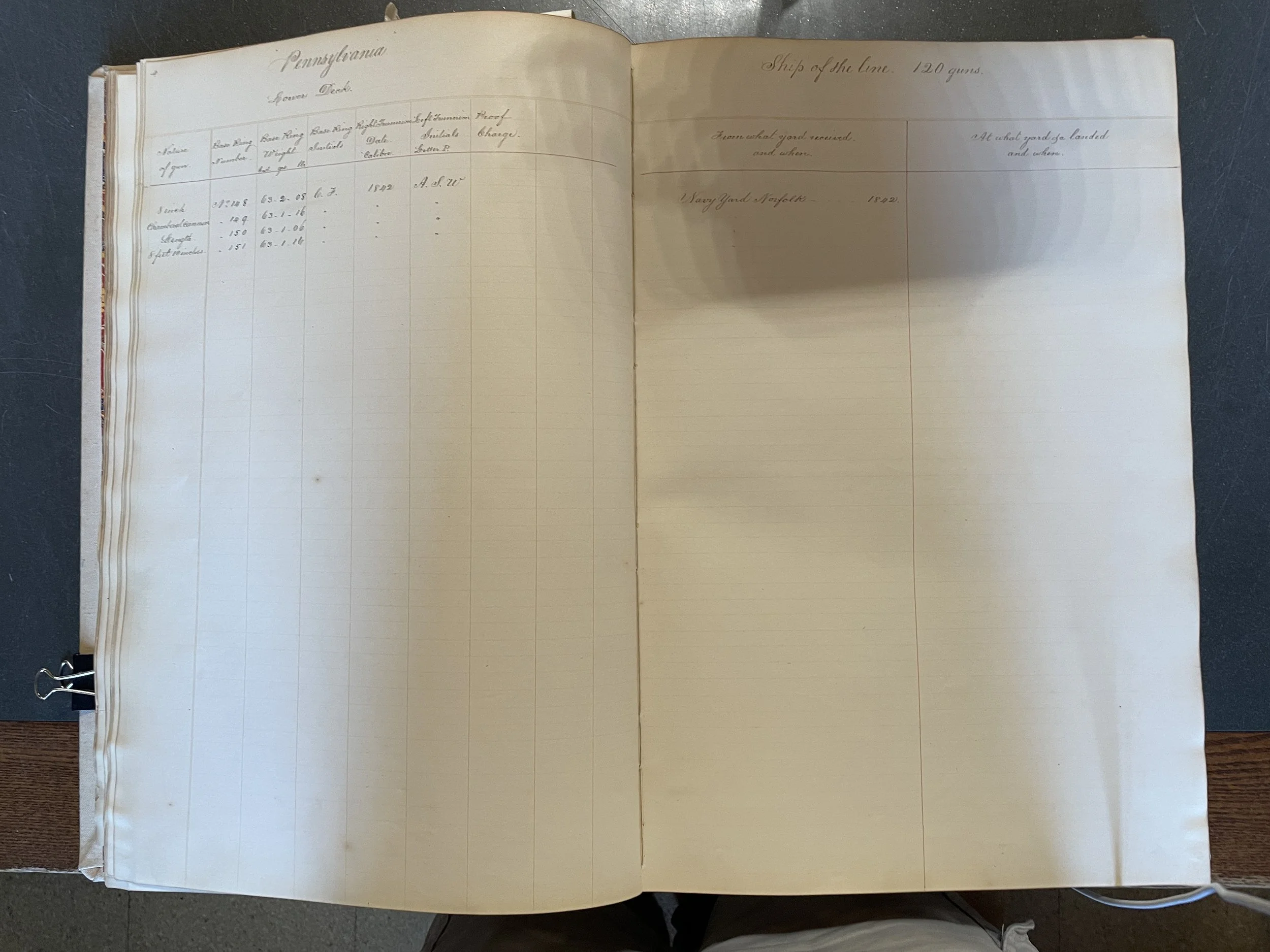
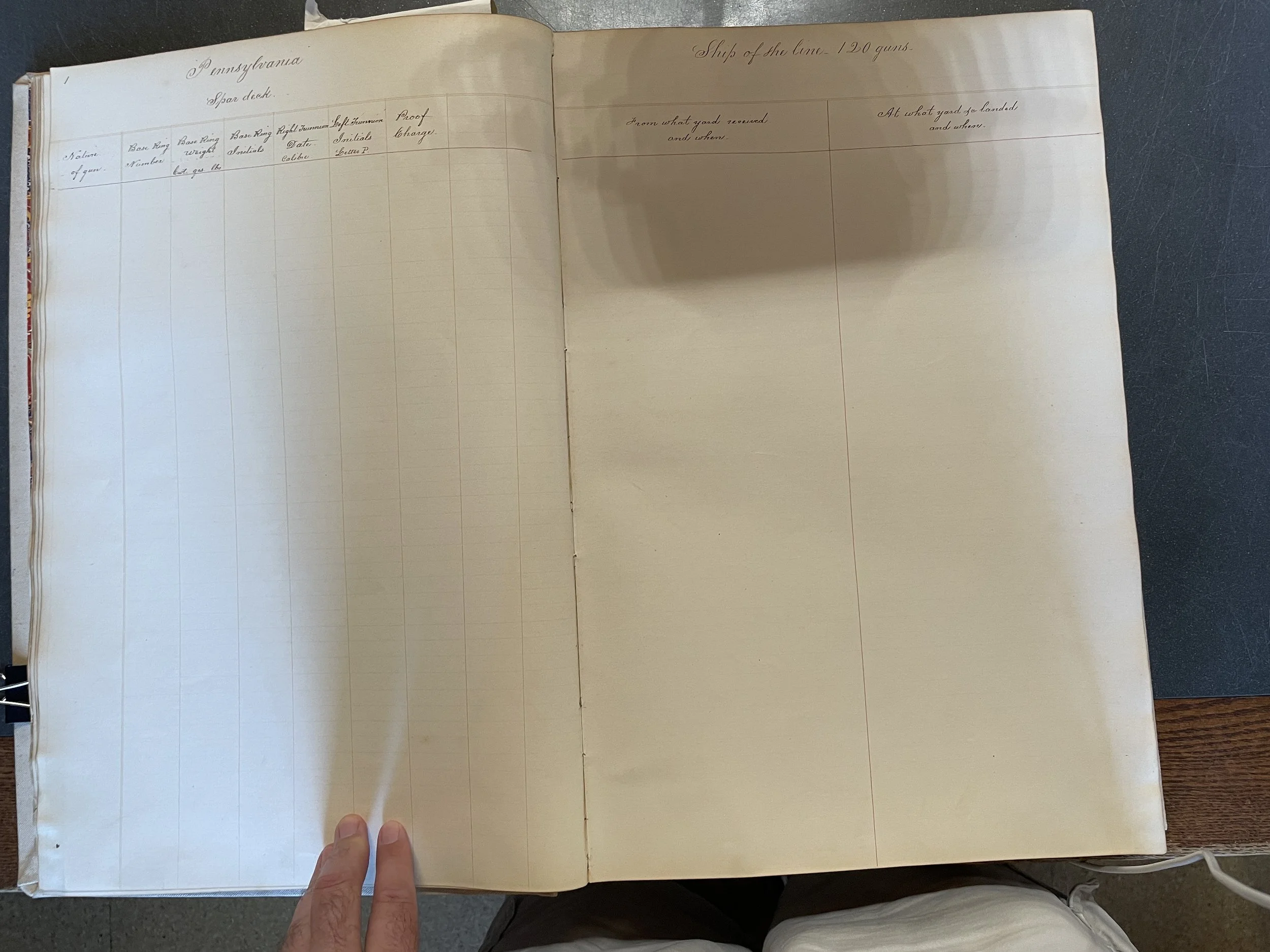
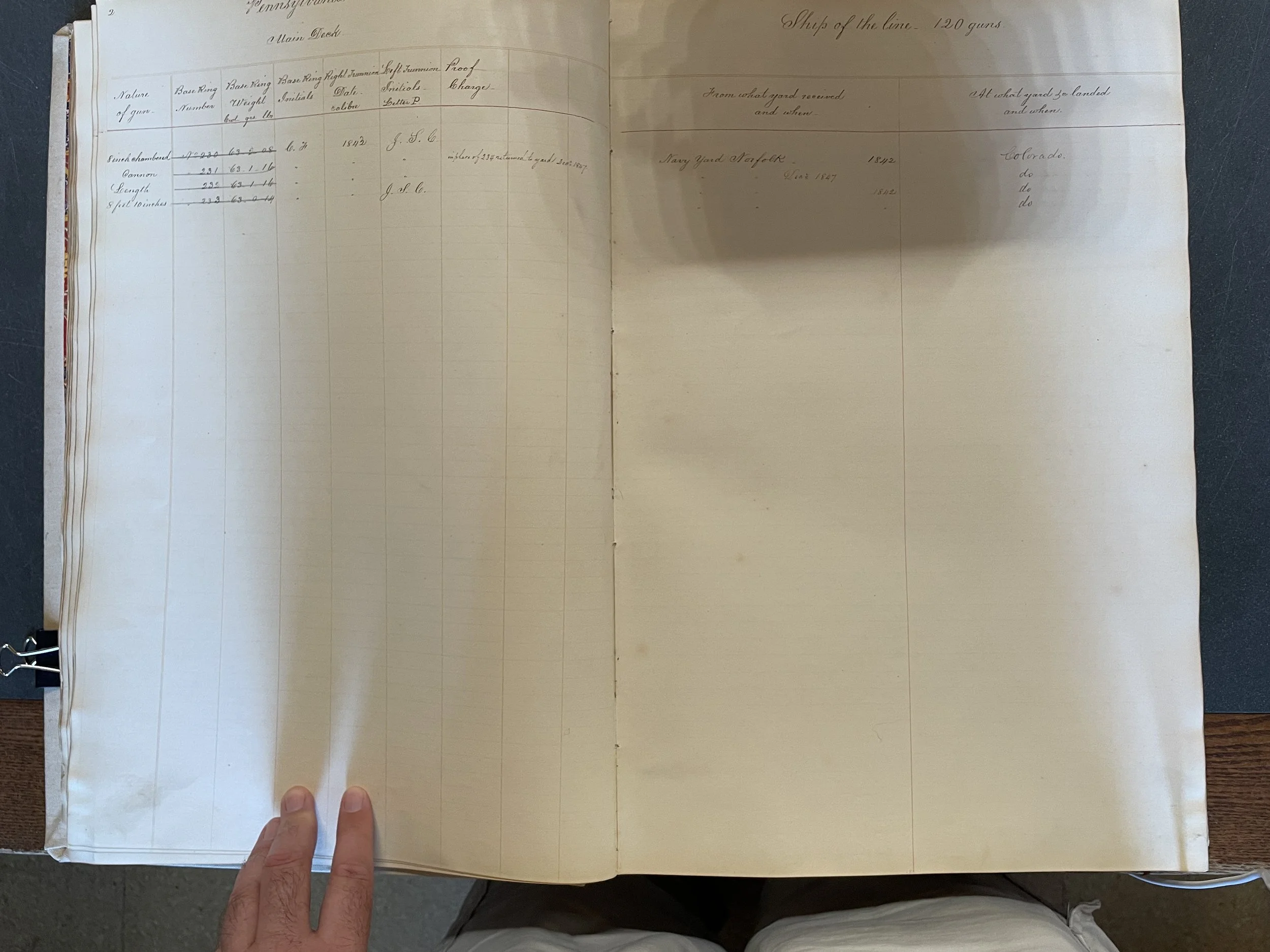
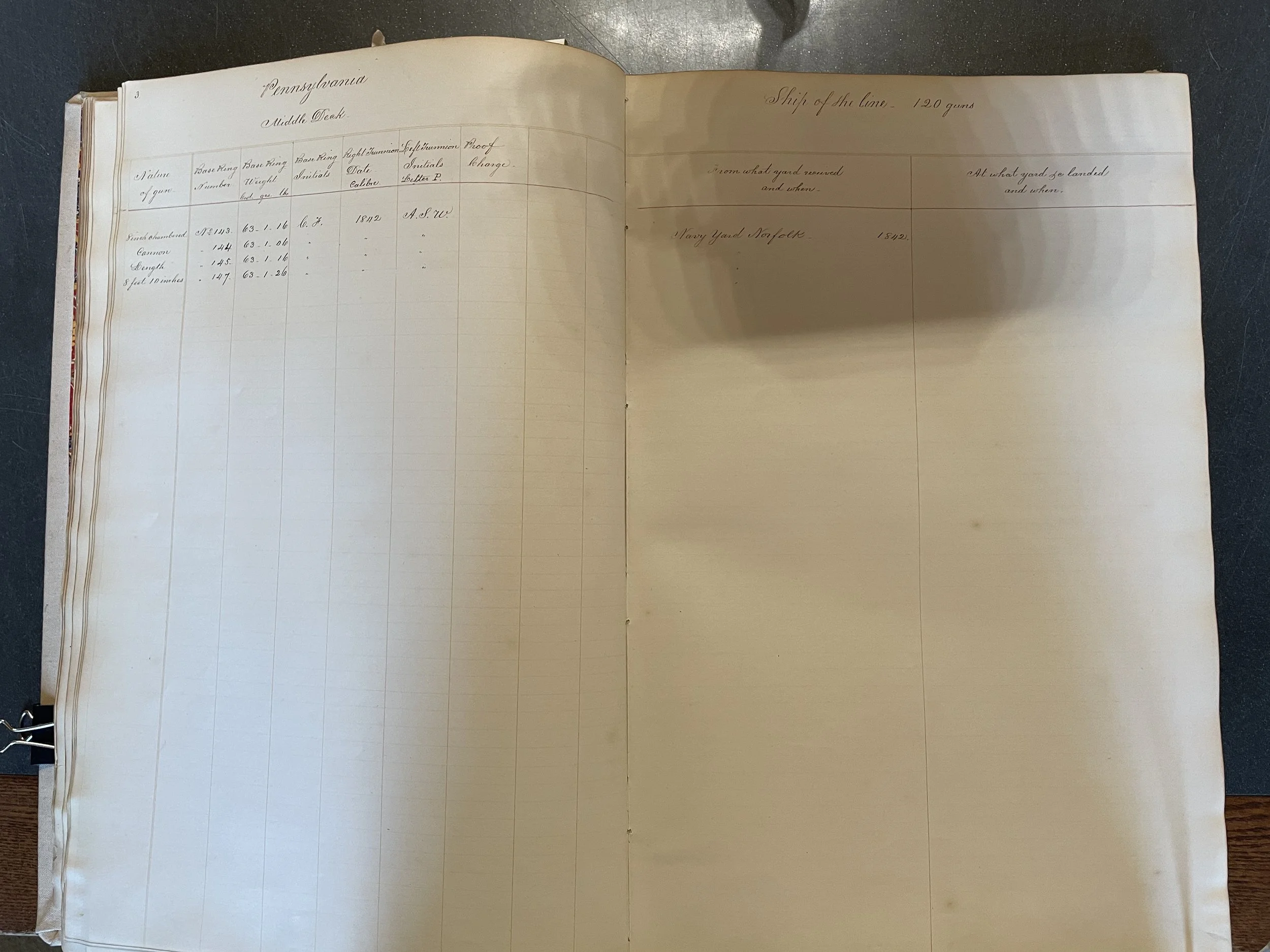
Through the 1840s USS Pennsylvania was reported as being in good condition and able to be prepared for sea very quickly. (See SecNav reports.) Though the ship would not be deployed aboard to show the United States flag at the head of a powerful battle squadron, she was in commission as a receiving ship. Along with USS Ohio at Boston and USS North Carolina at New York, she was fitted out to receive new sailors into Naval service. On her spacious decks, new sailors would get their first taste of naval life, and young midshipmen - there was still no Naval Academy - also saw their first service afloat, learning the “ways of the sea” as well as something of the Navy before they shipped out with the active fleet. They also received mathematical and navigational instruction from a school teacher on board. (Franklin, S.R. Memoirs of A Rear Admiral. Pp. 16-17).
USS Pennsylvania - Naval History and Heritage Command
In 1850 the first steam powered ships of the line appeared with the commissioning of the French ship Napoleon. In addition to building new wooden battleships, the great naval powers began converting existing sailing ships into screw-propelled warships. Combat in the Crimean War demonstrated just how superior the steam ships were to those with only sail power. In the mid-1850s the US Navy built a class of large steam frigates. The Merrimac and her sisters combined a long wooden hull, auxiliary steam power, and powerful new shell guns designed by John Dahlgren. Although frigates, the Merrimacs were among the world’s most powerful ships when built.
1850s illustration of a French frigate being lengthened for the purpose of adding steam machinery.
By 1860 it was quite clear that there was no place in a battle fleet for sailing ships armed with 32-pounders. In September of that year, the Secretary of the Navy directed a committee of officers to examine the possibility of converting the navy’s sailing warships to steam power. The committee quickly found that the sloops and frigates were unfit to be converted to steamers. The ships of the line, on the other hand, had plenty of space in their holds for boilers and machinery. However, the weight of the machinery and the requirement for stores of coal while maintaining all the stores needed on a ship at sea meant that the line of battle ships would need to be cut in half and a 50-foot additional section of hull added if the ships were to retain the same number of guns. The committee thought that such a conversion was both too extensive for older ships and would result in ships too expensive to operate. They did find that the ships could be razeed - the upper deck removed - which would allow the ships to carry a steam plant - as well as reducing the size of the crew. In Pennsylvania’s case, the plan was to remove the top two decks. The ships that were still on the stocks required the least work as their material condition was near pristine. Therefore they would retain the original gunports and carry a battery of 8-Inch shell guns and 32-pounders. Pennsylvania, though she had never seen sea service, was with North Carolina and Columbus, in need of new planking and enough work that it made sense to rearrange her gunports - giving her a smaller number or ports but the ability to mount larger guns. The report indicates that Pennsylvania would have received a battery of 9-Inch Dahlgrens and 8-Inch shell guns similar to that fitted to Merrimac and her sisters. The committee recommended that the conversions proceed as the resulting ships would be nearly as powerful as the purpose-built steam frigates, but they would cost half as much or less as building a new steam frigate (SecNav 1860. Pp. 32-36)
“Sectional View of the U.S. Steam Frigate Merrimac” showing the large space amidships required by boilers and engines. National Archives
The rapidly changing political situation meant that such plans were never put into place. As states began to secede from the Union in early 1861, the precarious position of Gosport Navy Yard became ever more apparent - especially after Virginia moved toward secession in the wake of the bombardment of Fort Sumter and President Lincoln calling for 75,000 volunteers in response. Southern officers at the Navy Yard began to resign their commissions. By the time Virginia seceded, three officers aboard USS Pennsylvania had “gone south” - her commander, her executive officer, and her Marine officer - leaving a single Lieutenant as the only line officer left aboard. Nevertheless, Pennsylvania remained in US Navy hands (Kinnaman, Stephen Chapin. A Crisis of Loyalties: The Destruction and Abandonment of the Gosport Navy Yard. Pg. 160).
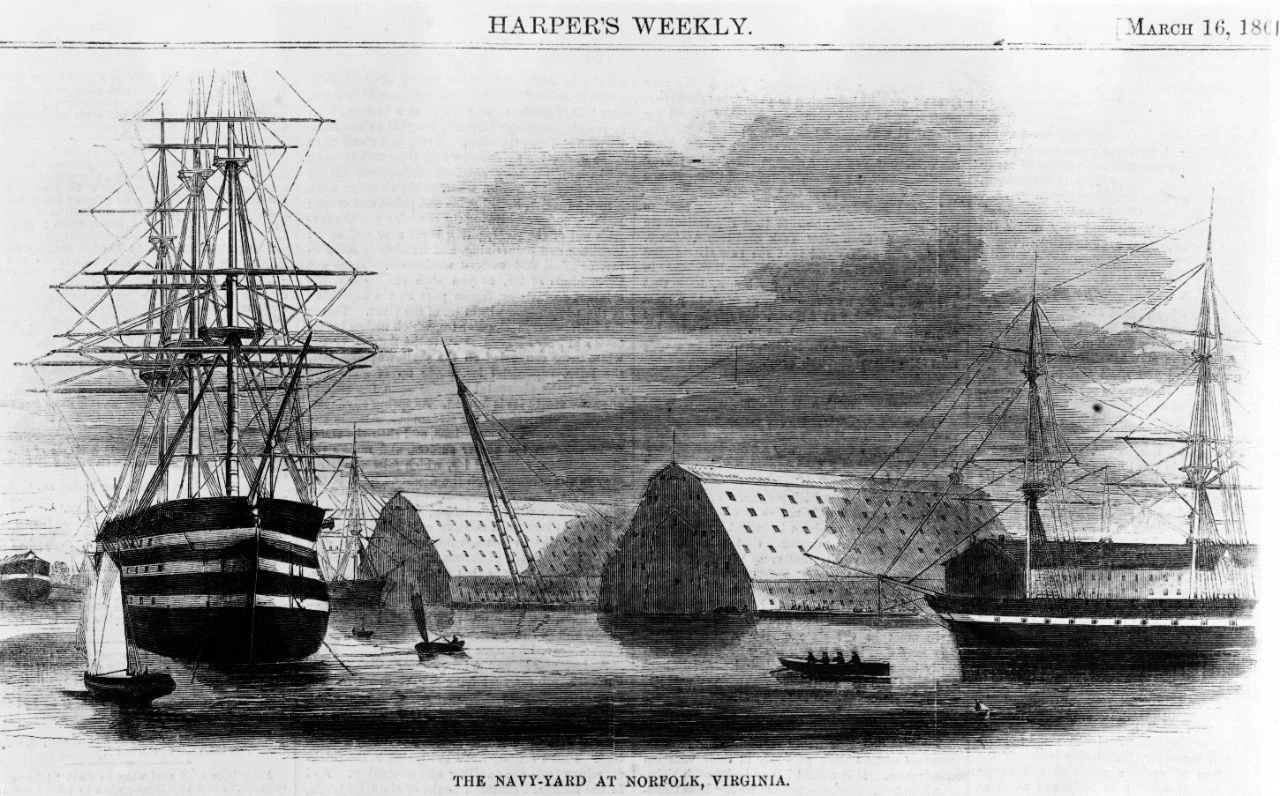
Harpers Weekly Illustration of the Gosport Navy Yard in March of 1861. The giant USS Pennsylvania is at right while the ship houses, one of which contained USS New York, are at center.
Commander Benjamin F. Sands was one of several officers ordered aboard USS Pawnee at Washington on Friday, April 19th, 1861. Pawnee was sent under Commodore William Paulding to save the Gosport Navy Yard and its ships, if possible, and destroy what could not be saved. Pawnee reached Norfolk at 8pm on the evening of April 20th. As Pawnee approached, they saw USS Pennsylvania’s guns trained on them - along with those of USS Cumberland. When Pawnee’s sailors answered USS Cumberland’s challenge, the sailors aboard Pennsylvania and Cumberland cheered at the arrival of Pawnee. However, the work of scuttling the ships at Norfolk had already begun, and the decision was quickly made to set everything to the torch. Sands was detailed to set fire to the ships and the ship houses. Soon the shiphouse holding the unfinished USS New York was aflame, along with several ships at anchor. According to Sands, Pennsylvania was not intentionally set aflame, but she began to burn as fire spread from other ships nearby (Sands, Benjamin F. From Reefer to Rear Admiral. Pp. 225-228).
Harper’s Weekly Illustration (Hand Colored) of the bonfire at Norfolk. In the bottom illustration, USS Pawnee leads USS Cumberland and the tug Yankee past the burning Pennsylvania. Displayed at the Hampton Roads Naval Museum
John W. H. Porter, a Confederate witness to the events around Norfolk wrote of the destruction of the yard:
“The old frigate United States, around which clustered so many memories of brave deeds and gallant victories, was the only vessel which was spared in the general devastation, and that night of the 20th of April was a night of anxiety in Portsmouth. The immense ship houses, with their millions of feet of timber, were scathing volcanos of flames, and the huge ship Pennsylvania was a pyramid of fire, while the burning Merrimac, Dolphin, Germantown, Plymouth, Raritan and Columbia and the large store houses added to the conflagration and lighted up the heavens with a lurid glare that was seen for thirty miles. To add to the dangers of the night the dwelling houses on the north side of Lincoln street in Portsmouth caught fire, and the whole city was threatened with destruction, which was only averted by a change of the direction of the wind. Occasionally one of the guns of the Pennsylvania, which had been left loaded by her crew, would be discharged as it became hot enough from the fire to ignite the powder, but, fortunately, no one was hurt by them, and amid all of this crackling of flames, booming of guns and deluge of falling sparks, the cry arose that the Pawnee was about to bombard the city” (Potter, John W. H. A Record of Events in Norfolk County, Virginia from April 19th, 1861 to May 10th, 1862, pg. 16).
USS Pennsylvania, the largest sailing warship ever built for the US Navy was reduced to that small portion of the hull which survived below the waterline. A photo taken later in the war purports to show salvage work being done on the remains of the ship.
“Wreck of U.S. Line of Battle Ship Pennsylvania” - Naval History and Heritage Command Photo
The most notable relic to survive from Pennsylvania is a 32-Pounder of 32 Hundredweight. Two of this type of light 32-Pounder were aboard Pennsylvania - likely for training and saluting purposes. It is one of the remarkable collection of historic Naval ordnance at Trophy Park at Norfolk Naval Shipyard.
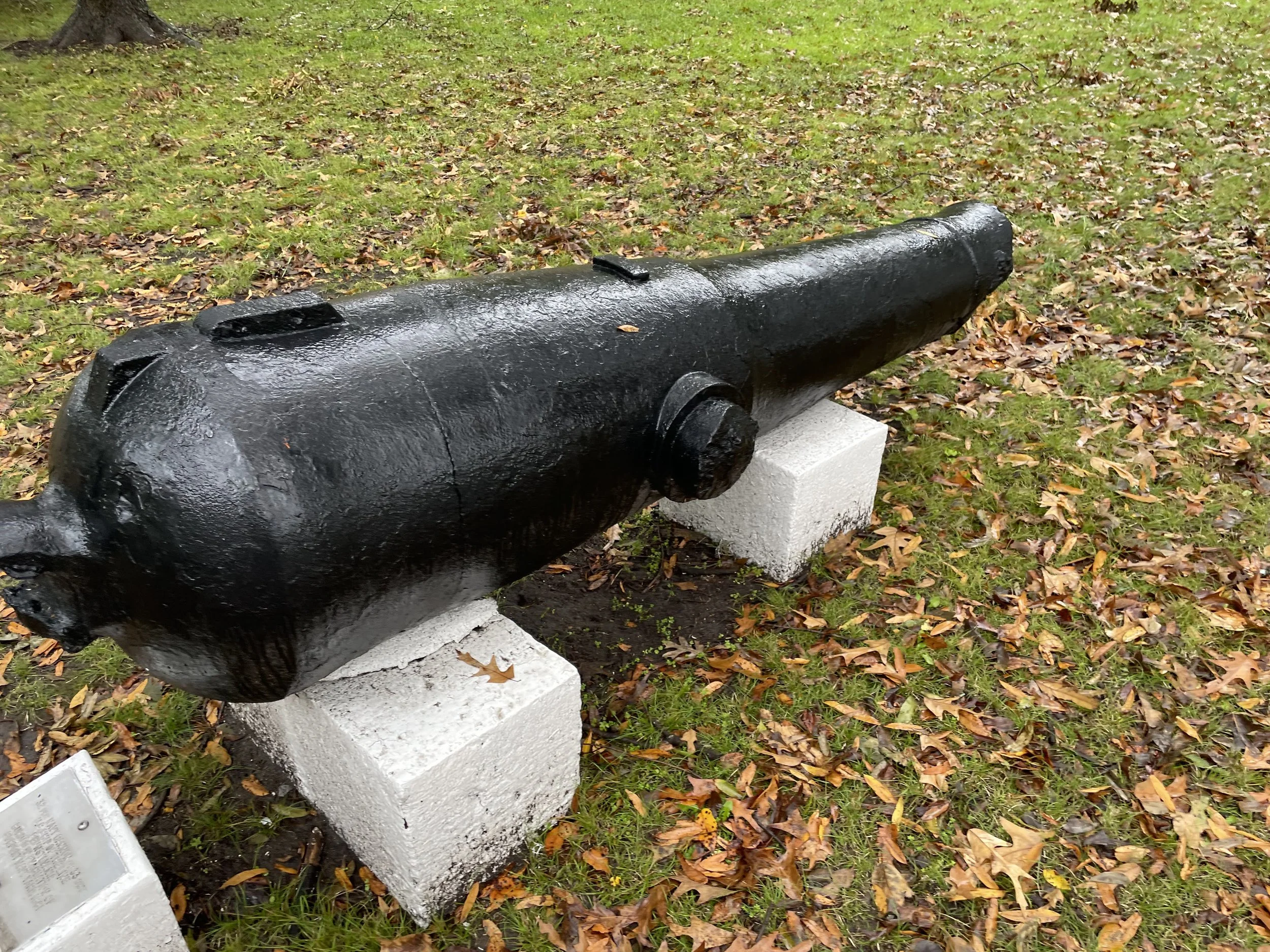
32-Pounder of 32 Hundredweight of USS Pennsylvania - See more on this gun here: https://www.santee1821.net/preserved-artillery/us-navy-32-pounder-of-32-hundredweight-of-uss-pennsylvania
I’ve heard it asked: “What if Pennsylvania hadn’t burned? What would have happened to her?”
The answer depends on who ended up with her. If the Confederates captured Pennsylvania intact, I don’t think they would have sent her to sea. By 1861 she was a dinosaur - which required an enormous crew of trained sailors - a resource that the South notably lacked. Merrimac was a far better candidate for conversion - as CSS Virginia eventually showed. There were no large marine engines to spare to fit to Pennsylvania. If she saw any service, it would have been as a floating battery to defend Norfolk. With Norfolk’s fall in 1862, she would have been burned by the retreating Confederates.
If Pennsylvania had been towed to safety, we might have photos of her like those of the other surviving US Navy Ships of the Line. Pictured here is USS Vermont. Naval History and Heritage Command.
If the US Navy had been able to hold Gosport or at least tow all of the ships to safety, I still think it unlikely that Pennsylvania would have seen active service. The US Navy made no effort to convert its other ships of the line into steamers. The need was for shallow draft ships to fight in the coastal waters and rivers of the southern states. Pennsylvania was simply too large to be useful. Pennsylvania would have likely seen out her days as a receiving ship at Boston or New York - or she might have been put to use as a store ship like USS Vermont and USS New Hampshire. Either way, I think we would likely have at least a couple of photographs of the great ship, like we do of the other “liners” which survived past 1861.
USS New Ironsides - Naval History and Heritage Command
The one circumstance in which Pennsylvania might have been useful is if the United States had come into conflict with a European power - such as with Britain in the aftermath of the Trent Affair. I suppose its just possible to imagine an utterly transformed Pennsylvania cut down to a single deck, mounting heavy Dahlgren guns, fitted with armor, and steaming out alongside USS New Ironsides - but that is a very long shot.
She was a beautiful ship. I’m thankful for the individuals who have spent time building models which pay tribute to her!
Model of USS Pennsylvania - Independence Seaport Museum
Pennsylvania was a magnificent ship. Had the US Navy needed to assert American interests in the 1820s, 1830s, or even 1840s, she would have been the flagship of a powerful fleet of large ships. Even kept under construction and in limited commission, the fleet in being meant that the European powers could not ignore the threat of American sea power as they had prior to the War of 1812. While it is a shame that Pennsylvania never was allowed to show the flag on the high seas and in ports of the world, and while I wish that she had survived long enough to be photographed, she fulfilled her mission in the long years of peace before the coming of Civil War.
USS Pennsylvania - Currier and Ives Lithograph - Library of Congress Image