US Navy 32-Pounder of 57 Hundredweight of USS Congress
US Navy 32-Pounder of 57 Hundredweight, Number 125, was carried aboard USS Congress.
US Navy 32-Pounder of 57 Hundredweight, Number 125, was carried aboard USS Congress - when she was sunk after surrendering to the ironclad CSS Virginia during the Battle of Hampton Roads in March 1862.
The 32-Pounder was cast by Fort Pitt Foundry in 1847. It is marked US Navy Registry Number 125. (The accompanying sign says “128”. However, published sources say “125.” Looking at the base ring, I believe I see “125.” As manufactured it weighed “58-0-4” (6,500 pounds). As a 32-Pounder of 57 Hundredweight, it is part of the System of Ordnance adopted by the US Navy in 1845.
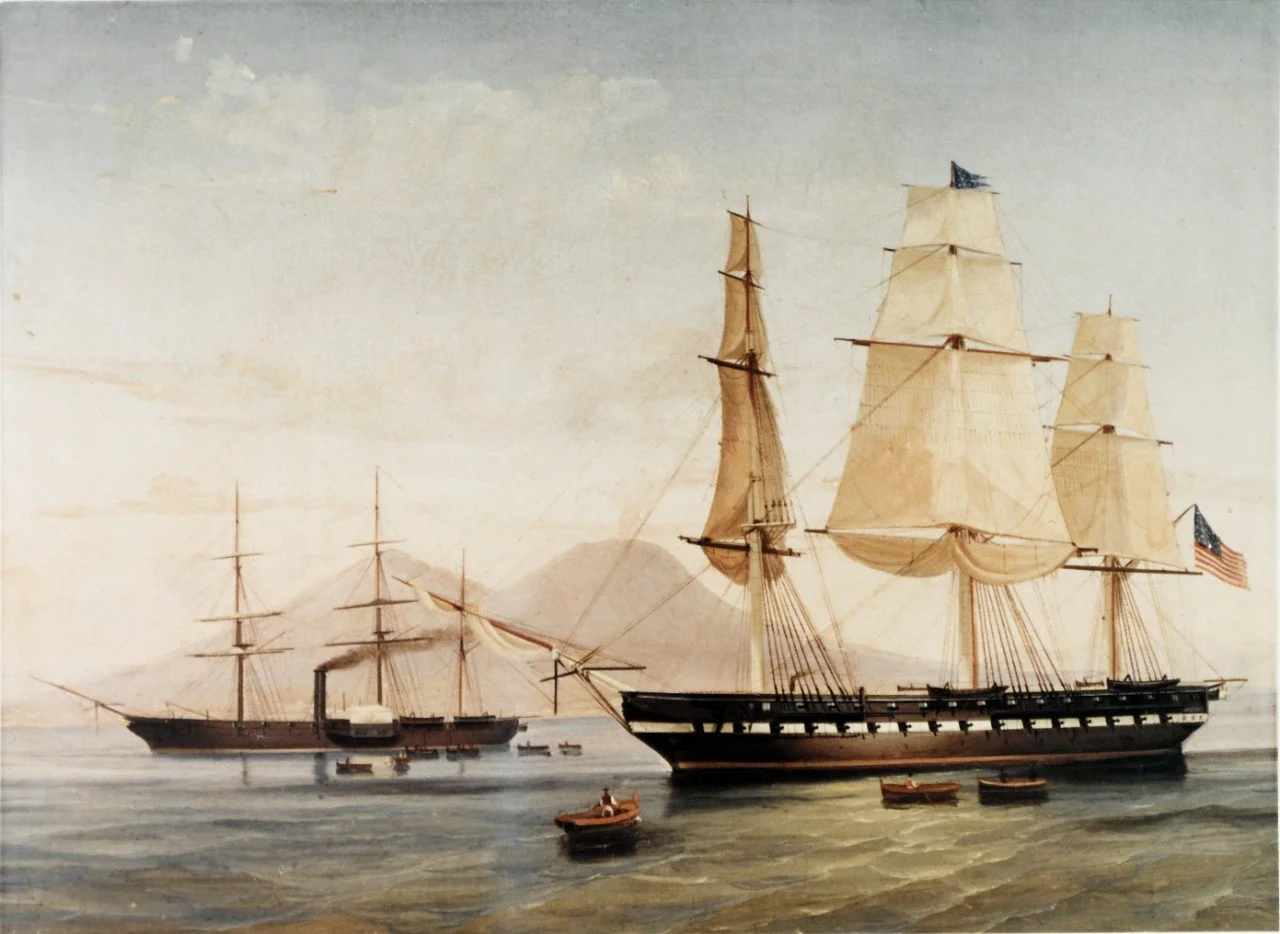
USS Congress (right) and USS Susquehanna (left) at Naples in 1857. Naval History and Heritage Command: https://www.history.navy.mil/content/history/nhhc/our-collections/photography/numerical-list-of-images/nhhc-series/nh-series/NH-01000/NH-1310-KN.html
USS Congress had been the pride of the sailing navy when she commissioned in 1842. She was the last and largest sailing frigate to be designed for the US Navy. USS Constitution had set a standard for heavy frigates - and the design of the victorious ship had been the model for three frigates built during the War of 1812 and, in an improved and enlarged form, nine more begun in the early 1820s. USS Congress was, to put it simply, a “Super-Constitution.” She was just four feet longer than the old frigate, but a wider beam and fuller hull shape meant that she was about 25% greater displacement. Whereas the earlier frigate carried a main battery of 24-pounders, heavy for their day, USS Congress comfortably carried 32-pounders on her gun deck. Like Constitution, her spar deck carried primarily carronades as original fitted out. Despite her greater size, Congress was found to be a fast and maneuverable ship. Had the age of steam and shell guns not been just over the horizon, she likely would have had sister ships built to her design.
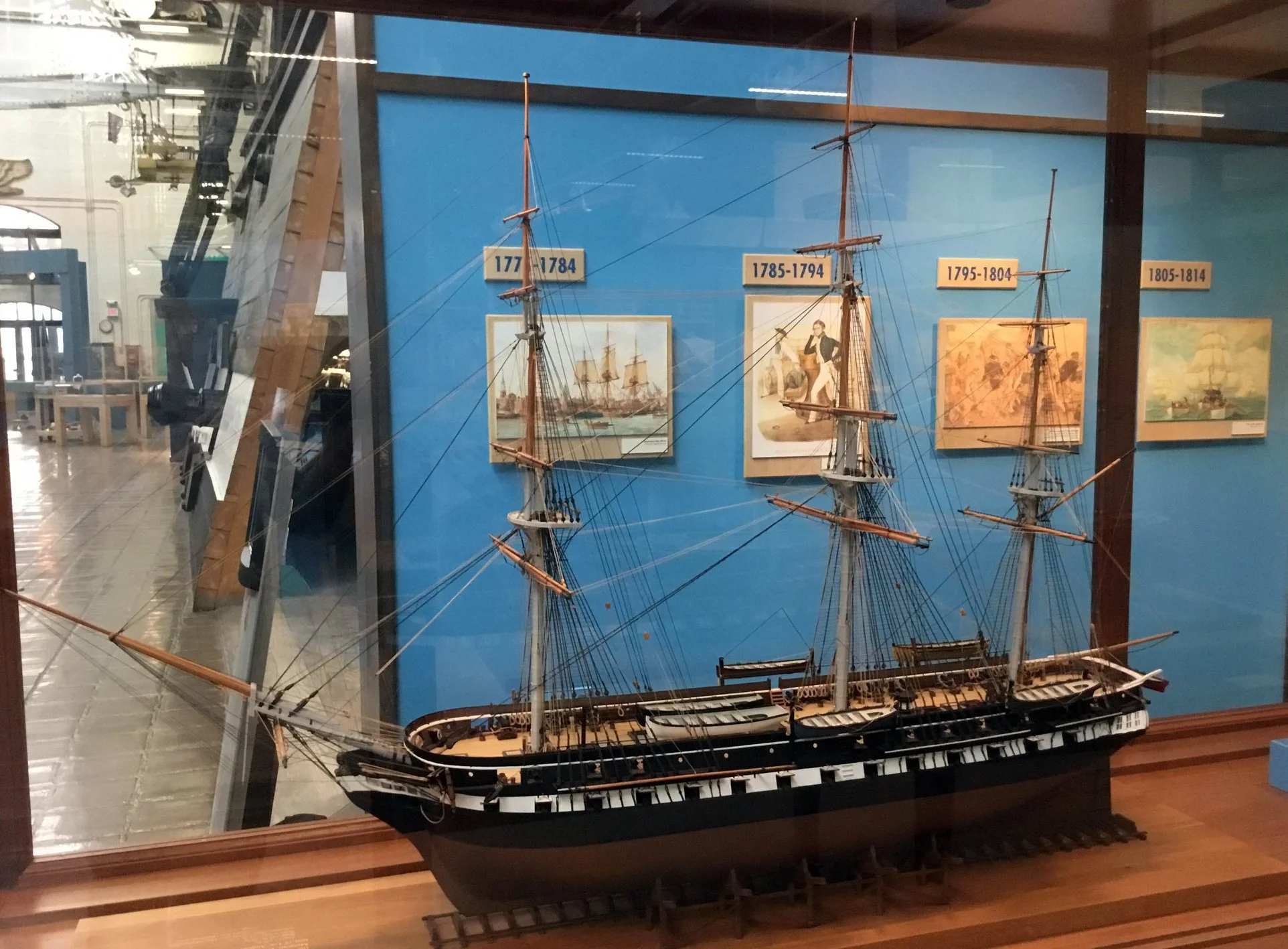
Model of USS Congress at the National Museum of the United States Navy. NMUSN Photo.
A fascinating account of life aboard USS Congress in 1845-1846 may be found in the book My Voyage Aboard the United States Frigate Congress written by Elizabeth Douglas Turrill Van Denburgh who, at age 13, travelled with her family from Norfolk to Honolulu when her father was appointed as the Consul General representing the United States to the Kingdom of Hawaii.
USS Congress served on the Pacific coast during the Mexican-American War. Detachments from her crew served ashore during in the California Campaign of the Mexican-American War. In the 1850s she served as a flagship of the Brazil Squadron and then the Mediterranean Squadron.
It was likely during the early 1850s that USS Congress was given a new armament. The older model 32-Pounders on the gun deck and carronades on the spar deck were removed. She was rearmed with forty 32-Pounders and ten 8-Inch shell guns. If the armament followed the regulations established for the other, slightly smaller, “First Class Frigates”, twenty-four 32-Pounders of 57 Hundredweight, like Number 125, and sixteen 32-Pounders of 33 Hundredweight were mounted - with the lighter guns being placed on the spar deck. However, the most effective part of the new armament were the 8-Inch shell guns of 63 hundredweight, each capable of firing a 50-pound explosive shell.
Gun deck armament of USS Congress in the Bureau of Ordnance’s “Armament of Naval Vessels” (NARA RG 75 Entry 111 Volume 1).
Gun deck of USS Constellation at Baltimore. Congress would have looked similar, though wider and longer - with fifteen rather than ten guns a side. The type of guns carried was the same, however, a mix of 32-Pounders of 57 Hundredweight and 8-Inch shell guns of 63 Hundredweight.
“The Sinking of Cumberland”. USS Congress is likely meant to be the ship in the left background. Via the Library of Congress: https://www.loc.gov/item/2001705847/
With the coming of the Civil War, USS Congress was stationed at Hampton Roads as part of the Atlantic Blockading Squadron. It was there on March 8th, 1862 that she was anchored near USS Cumberland when the two ships were attacked by the ironclad CSS Virginia. On her way to ram Cumberland, Virginia passed alongside Congress and the frigate and the ironclad exchanged broadsides. Congress’s 32-Pounder shot bounced harmlessly off the iron casemate of Virginia. Seeing Cumberland sunk by the ram, Congress slipped her anchor cable and ran aground to avoid sinking by ramming. However, Virginia took position off of Congress’s stern. The frigate’s crew could only reply to the ironclad’s explosive shell and red-hot shot with two of guns moved to the stern. These were soon disabled, and with the ship on fire in several places her senior surviving officer struck her colors.
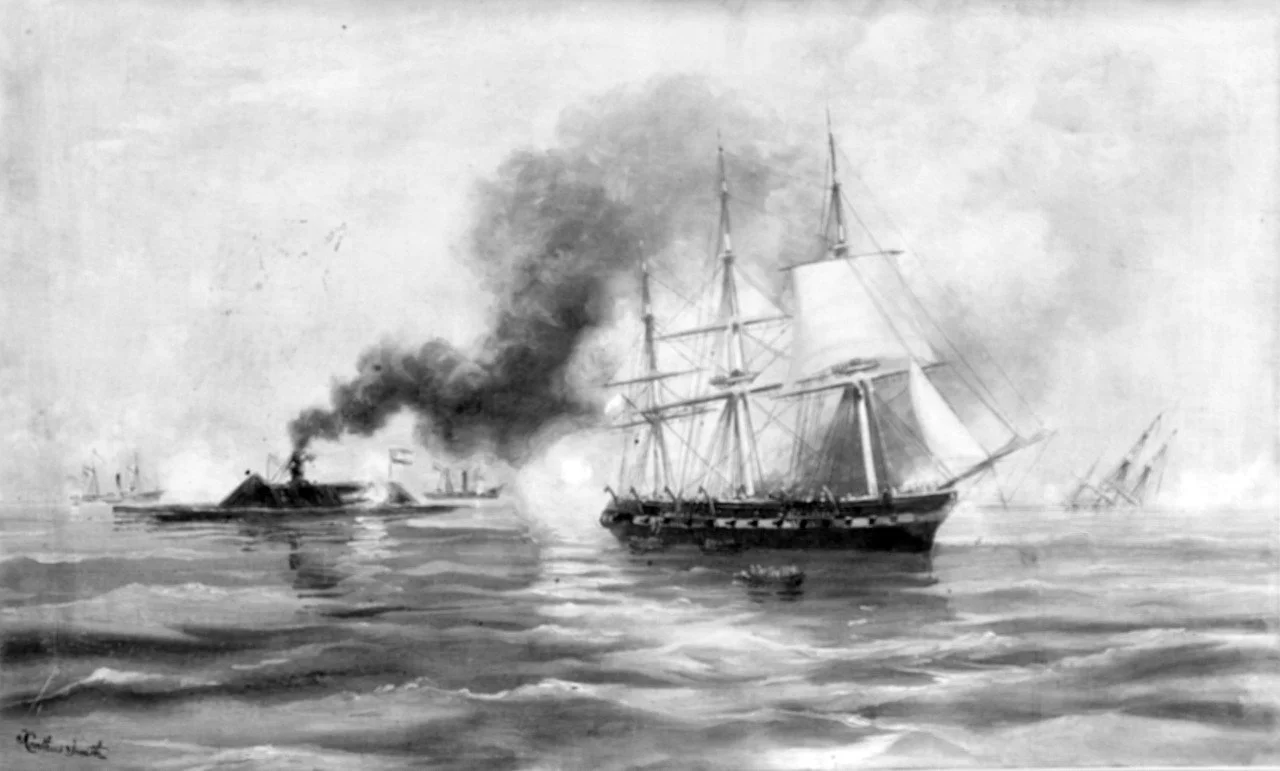
CSS Virginia firing into the stern of USS Congress. Naval History and Heritage Command: https://www.history.navy.mil/content/history/nhhc/our-collections/photography/numerical-list-of-images/nhhc-series/nh-series/NH-42000/NH-42218.html
The Burning of USS Congress. Naval History and Heritage Command: https://www.history.navy.mil/content/history/nhhc/our-collections/photography/numerical-list-of-images/nhhc-series/nh-series/NH-55000/NH-55328.html
Fire from US Army troops ashore meant that the Confederates could not take possession of Congress, and Virginia opened fire on the surrendered vessel despite a white flag flying from the ship. With Congress’s surviving crew swimming for the shore - the fires aboard went uncontrolled, the ship eventually exploding when they reached the magazine. One hundred-twenty of Congress’s crew were killed in the action, with about another forty wounded - out of a complement of four hundred thirty-four.
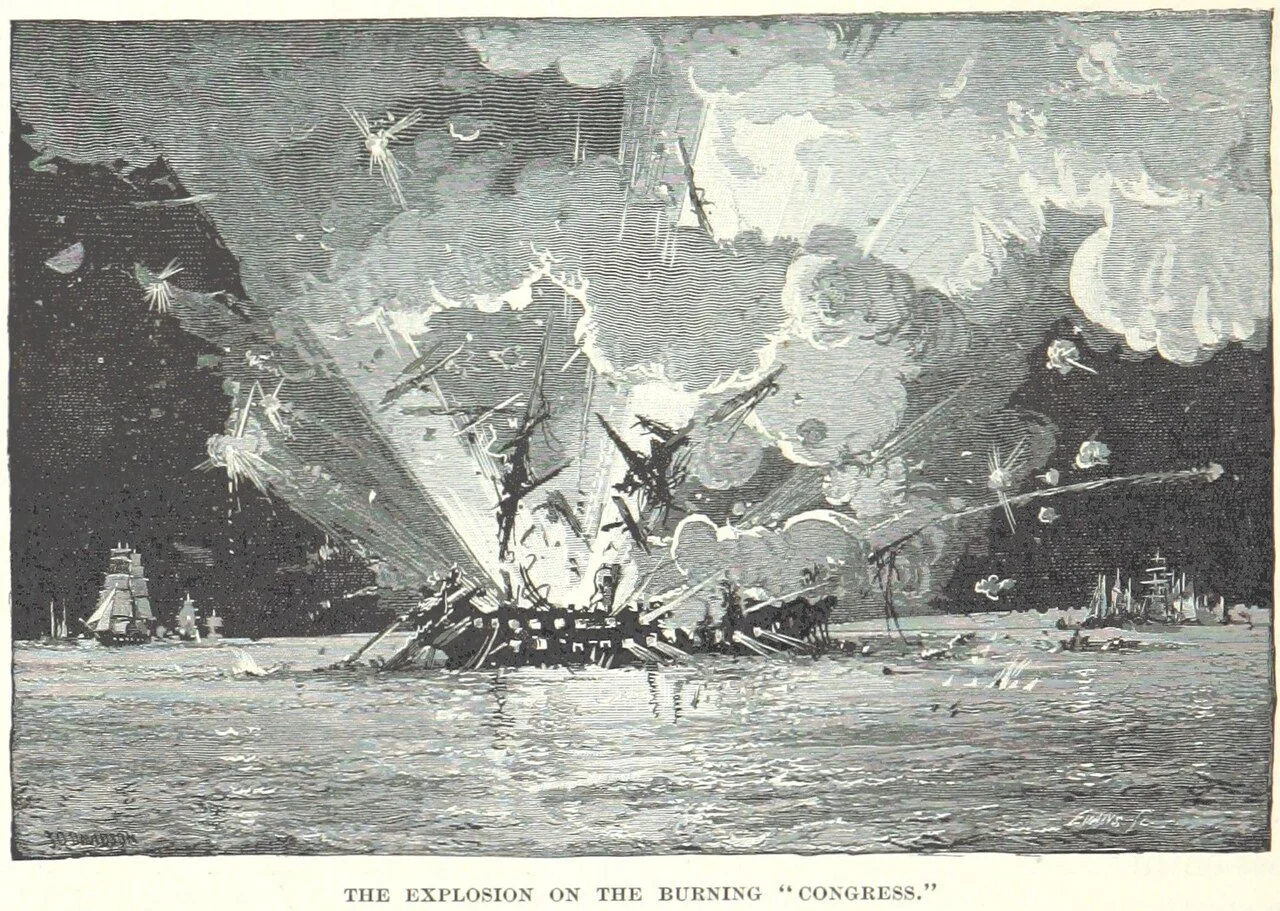
The Explosion of USS Congress
In his report, Congress’s senior surviving officer credited the hot shot fired by Virginia with starting uncontrollable fires “three times in the sick bay and wardroom and twice in the main hold.” One of the 9-Inch Dahlgrens which were set up aboard CSS Virginia to fire shot which had been heated red-hot survives at the Mariners’ Museum in Newport News - with it’s muzzle shot away from the action with Congress and Cumberland.
9-Inch Dahlgren of CSS Virginia - showing the damage to the gun from the battle with USS Cumberland and USS Congress.
USS Congress was salvaged by the US Navy in 1864. Most of the guns raised were condemned as no longer serviceable. Whether it was still usable or whether just as a monument to the destroyed ship and the fallen crew, Number 125 was preserved. It is on display at Trophy Park at Norfolk Naval Shipyard, not far from where the Battle of Hampton Roads was fought.
The registry number is stamped at the top of the base ring between the sight block and the hammer block. I believe I read “125”, though accompanying sign says “128.” Olmstead et al., states “125”.
As manufactured the 32-Pounder weighed “58-0-4” in hundredweight (6,500 pounds)
32-Pounder 57cwt Number 125 viewed from the breech.
The plaque beside the 32-Pounder gives its Registry Number as 128
The muzzle of the 32-Pounder showing the rather old fashioned features of the chase and muzzle - when compared to the more “modern” features of the breech.”
US Navy 32-Pounder of 57 Hundredweight Number 494 in Hudson, New Hampshire showing a well preserved example of the type on a replica carriage. See additional photos here: https://www.santee1821.net/preserved-artillery/32-pounder-of-57-hundredweight-in-hudson-new-hampshire
US Navy 32-Pounder of 57 Hundredweight Number 125 at Trophy Park
Monument to the Crews of USS Cumberland and USS Congress at Naval Medical Center Portsmouth Cemetery
Plaque on the monument to Congress and Cumberland
Sources
Canney, Donald L. Sailing Warships of the US Navy. Naval Institute Press, 2001.
Chapelle, Howard I. The History of the American Sailing Navy: Their Ships and Their Development. W.W. Norton, 1949.
March 9th, 1862 Report of Lieutenant Arthur Pendegrast. Official Records - Navies. Series 1. Volume 7. Pages 23-24.
Olmstead, Edwin, Stark, Wayne E., Tucker, Spencer C. The Big Guns: Civil War Siege, Seacoast, and Naval Cannon. Museum Restoration Service, 1997.
Tucker, Spencer. Arming the Fleet: U.S. Navy Ordnance in the Muzzle-Loading Era. Naval Institute Press. 1989.
“The Cannons at Trophy Park” an article on NAVSEA’s website based on the research of Mr. Wayne E. Stark. https://www.navsea.navy.mil/Home/Shipyards/Norfolk/About-Us/History/CannonsatTrophyPark/
, Van Denburgh, Elizabeth Douglas Turrill. My Voyage Aboard USS Congress. New York, 1913.