9-Inch Dahlgren at Old Fort Jackson
9-Inch Dahlgren displayed at Old Fort Jackson outside of Savannah, Georgia
Updated 6/20/26: US Navy 9-Inch Dahlgren Number 116 served was cast at Tredegar Foundry in 1857. It was part of the original armament of the steam frigate USS Colorado (a sister to USS Merrimac) which was built at Norfolk. Number 116 was aboard Colorado during her 1858 service in the Caribbean. After Colorado returned to Boston, she was placed in ordinary. In December 1858, six Dahlgrens (Number 111 - 116) were transferred from USS Colorado to USS Brooklyn, a new steam sloop building in New York (National Archives, RG 74 Entry 111. Vol 1. Pp 116-117, DANFS).
Number 116 was one of twenty-two 9-Inch Dahlgrens carried by Brooklyn during the American Civil War. As such, Number 116 is a witness to Brooklyn's relief of Fort Pickens, the Battle of Forts Jackson and St. Philip, the Vicksburg Campaign, the Battle of Mobile Bay, and the two bombardments of Fort Fisher. Brooklyn had one of the most significant war records of any ship in the US Navy - and 116 was a witness to all of it. Number 116 was removed from Brooklyn at Philadelphia in 1867 and seems to have seen no further service until installed upon USS Ossipee in 1884 (RG 74 E111, Vol 2. P. 12; RG 74 E112, Vol 1. Pp. 188-189, DANFS).
USS Ossipee, a sister of USS Housatonic which was sunk by Hunley, was a steam sloop built at Kittery in 1861-1862. She had an active career - including fighting alongside USS Brooklyn at Mobile Bay. From about 1880 to 1885 the old ship was rebuilt at League Island (Philadelphia Navy Yard) in a refit that consumed twice the ship's original construction cost. The "rebuildings" of the 1870s and 1880s often were cover for the Navy to build new ships using the repair budget. While the Navy should have been building new warships in iron and steel, it instead spent vast sums on old wooden sail-and-steam ships armed with muzzle loaders from the Civil War. Ossipee emerged from the refit with a new armament of one 8-Inch Muzzle Loading Rifle, six 9-Inch Dahlgrens Numbers 111 to 116 which had all previously served together on Colorado and Brooklyn, and a 60-Pounder Parrott Breech Loading Rifle. (See Canney "Frigates, Sloops, and Gunboats, pp. 95, 161; Annual Reports of SecNav for 1878-1885; Logbook of USS Ossipee 1885, DANFS).
Number 116 was fired 317 times in US Navy service. Numbers 111-116 served aboard USS Ossipee until the ship decommissioned at Norfolk in 1889 (they were taken off in 1891). While Number 112 and 115 were sent to be a saluting battery at St. Helena in 1893, Numbers 111, 113, 114, and 116 were transferred to Yards and Docks that year (RG 74 E112, Vol 1. Pp. 188-189).
Number 116, like many surviving US Navy guns, spent many years as a bollard at Norfolk. It eventually was removed from concrete where it had spent nearly a century and was privately purchased. Along the way a portion of the chase was broken. In 1997 it was purchased by the Coastal Heritage Society, given a 7-inch steel sleeve, and mounted at Old Fort Jackson. At Fort Jackson it represents both the Columbiads mounted at the historic fort and the use of naval guns captured at Gosport in 1861 by the Confederates in fortifications (Fort Sumter mounted two 9-Inch Dahlgrens on its barbette during the April 7th, 1863 action with the US Navy, for instance). For a number of years, Number 116 was used in firing demonstrations at the fort - being one of the largest Civil War era guns regularly fired. Videos of 116 firing can easily be found online (Old Ford Jackson Records and Social Media Posts).
Old Fort Jackson is an amazing and beautiful site on the Savannah River to visit with a very knowledgeable and friendly staff. Just be sure to wear lots of bug spray if you visit in the summer months.
A video of the Dahlgren being fired can be seen here.
The Type: The 9-Inch Dahlgren could fire either a solid round shot weighing about 90 pounds or an explosive shell weighing around 73 pounds with a maximum 10 pound propellant charge. The shell, a spherical projectile cast with a hollow core for filling with three pounds of gunpowder, was designed to imbed itself in the side of a wooden ship before exploding. Few wooden ships could survive the damage caused by more than a handful of such hits. Against ironclads, a maximum 13 pound propellant charge was authorized, though combat actions against CSS Virginia, USS Monitor, CSS Albemarle, and CSS Tennessee showed that the 9-Inch Dahlgren was largely ineffective against ironclads. The 9-Inch Dahlgren was the standard heavy broadside cannon aboard the heavy frigates and sloops of the US Navy during the American Civil War. It continued to served into the 1890s aboard US Navy sloops. See: https://www.santee1821.net/service-charges-for-naval-guns-in-the-civil-war
Post war photo of USS Brooklyn. US Naval History and Heritage Command Photo https://www.history.navy.mil/content/history/nhhc/our-collections/photography/numerical-list-of-images/nhhc-series/nh-series/NH-56000/NH-56578.html
The Dahlgren viewed from the parade ground inside the fort.
The Dahlgren can be seen at center left above the parapet.
Additional Photos of the Dahlgren


USS Ossipee following her 1880s refit. Note the large gunport for the 8-Inch Rifle. Library of Congress Photo
“Abandoned Ship” drill aboard USS Ossipee in the late 1880s. Five of Ossipee’s six 9-Inch Dahlgrens are visible in this photo. Naval History and Heritage Command Photo
Page for USS Colorado’s armament at commissioning in 1858 in BuOrd’s “Armament of Naval Vessels” National Archives, RG 74 Entry 111. Vol 1. Pp 116
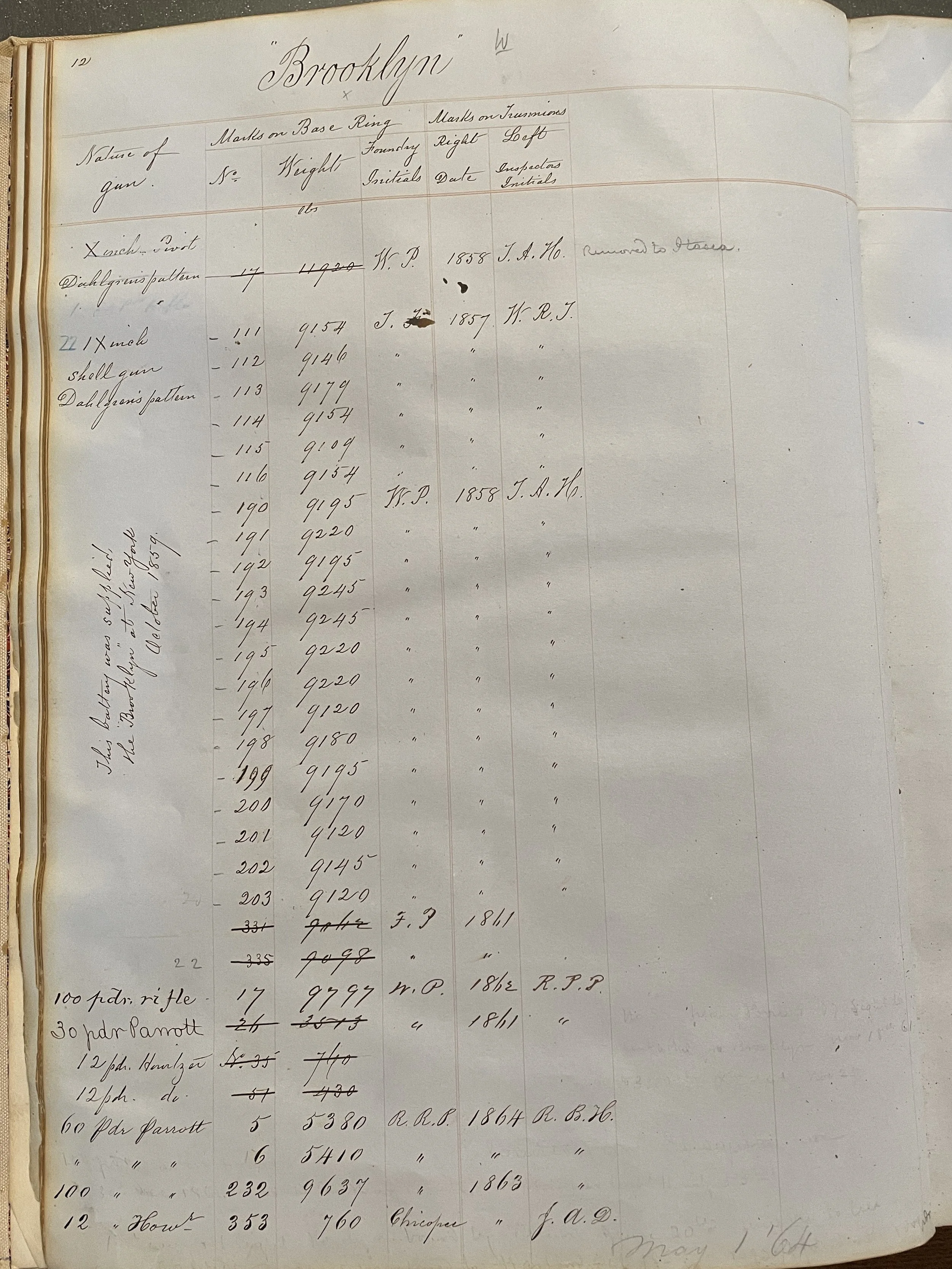
Page for USS Brooklyn in BuOrd’s “Armament of Naval Vessels” National Archives RG 74 E111, Vol 2. P. 12
1885 Logbook of USS Ossipee - National Archives: https://catalog.archives.gov/id/33217668?objectPage=48
9-Inch Dahlgrens Number 111-116 appear on this page in the Bureau of Ordnance’s “Register of Naval Guns”. Find a higher resolution image on the BuOrd Records Page.